


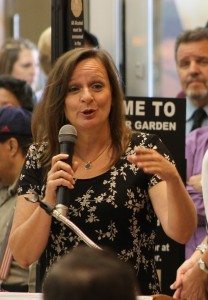
Credit: Tom Sofield/LevittownNow.com
After years of debate and controversy, Bristol Township is preparing to solidify local regulations that will help govern the municipality’s surge of rogue recovery homes.
The township’s governing council, after first experiencing technical difficulties, discussed impending ordinance amendments late into the evening Tuesday. The discussion, led by Solicitor Randy Flager and Vice President Amber Longhitano, evaluated the current rogue home issue with local residents as well as some of the owners of voluntarily-regulated township recovery homes governed by the Pennsylvania Association of Recovery Residences (PARR) and the Bucks County Recovery House Association (BCRHA).
Advertisements
Bryan Kennedy, the owner of three recovery homes under the Independence Lodge umbrella; Michelle Kaisinger, the owner of five recovery homes managed by Emilie House; and Barbara Williamson, the owner of five recovery homes referred to as Way of Life Recovery, all gave testimony Tuesday night in favor of the amended ordinance.
The ordinance changes, which Flager and Longhitano both said needs some minor wording changes, will be re-advertised and are expected to be approved at the township’s next scheduled council meeting in August. Councilman Patrick Antonello noted that the ordinance in its entirety will be made available on the township website soon for resident review.
According to Flager, the amended ordinance will change the definition of a family and provide a definition for a recovery home, restrict recovery homes to the residential, commercial and neighborhood commercial zoning districts, require distancing of 300 feet between recovery homes, require specific parking regulations and require recovery homes to be governed by either a local (BCRHA), state (PARR) or federal association.

Credit: PCN
Advertisements
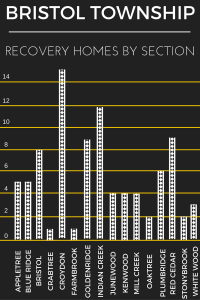
While the BCRHA currently governs about approximately 72 homes owned by 15 different individuals, about as many as half of the estimated recovery homes in the township are without regulations, something the township seeks to fix with the passing of the amended ordinance. These homes, which according to governed recovery home owners, do not offer a sober living program but instead provide space to anyone clean from drugs or not, are referred to commonly as “rogue homes.”
When Williamson, 28, left Livengrin after being homeless in Kensington, she said she was lucky enough to get a spot at Emilie House to continue her path to sobriety; others like Kennedy, weren’t so lucky. Kennedy, who now owns Independence Lodge, went through a rogue home seven years ago and said it was because he “didn’t know any better” – Kennedy’s success staying clean in a rogue home is a rare positive story that’s come out of the unregulated system.
Advertisements
“I was one of those knuckleheads, but I was brought back to life in a great positive way,” said Kennedy. He remarked to the board that although there may be a negative connotation behind those living in recovery homes, he’s had Wall Street guys, military service members, and even active duty police officers come through Independence Lodge.
For Flager and Longhitano, the issue has never been with owners like Williamson, Kennedy or Kaisinger, it’s with those who have no education on recovery and instead open homes as a real estate or business opportunity; allowing those who come in and out to be co-ed, start romantic relationships with others in recovery, and even continue to use drugs or alcohol as long as their rent is paid.
“The need has been met in Bristol Township. If all the houses were well-run we wouldn’t be here,” said Kaisinger as part of her testimony Tuesday night. “I could buy five houses tomorrow and fill them, there is definitely a need for good sober living environments, but we have enough in Bristol Township.”
Advertisements
For recovery home owners seeking to keep their patients on a strict, clean-living program, having so many recovery homes in such short proximity can be detrimental. Williamson told the board that she has had a rehab facility on their way to transport a resident of her home back to treatment and the resident has instead walked to a rogue home in the township. When asked why she supports the amended ordinance, Williamson said she ‘believe’s in a higher standard’.
Debbie Fleming and her family have witnessed first-hand the effect of rogue homes. The Goldenridge resident of 36 years remarked to the board that she can see two self-declared rogue homes from her kitchen window. While Fleming gave support for the amended ordinance, she said the township needs even further distancing requirements than 300 feet.
Advertisements
“Obviously I’m not going to oppose it, because it’s better than nothing, but if you have a house on one end of a football field and another house on the other end, that’s just too close; 300 feet is nothing.”
Flager, who connotated his hands are somewhat tied, has amended the ordinance to reflect what the township is legally capable of doing.
Advertisements
The passing of the ordinance, according to Flager, will end the local portion of a months-long writing and re-writing process with Longhitano to help protect not only the residents, but the residents of the 100+ township recovery homes.
Related:
- Proposed Recovery House Regulations Released For Public Review
- Middletown Approves Regulations For Recovery Homes
- Recovery House Hearing: ‘Levittown Today Is Becoming Kensington And Frankford Because Of Increased Drug Activity’
- Recovery Home Crisis: ‘Every One Of These People Deserve This Chance’
- Officials Announce Support For Recovery House Moratorium
- Recovery Homes Issue Draws Huge Crowd At Bristol Twp. Council Meeting
- Hearing on Recovery Houses Points to Safety Issues & Differences

