By Stephen Caruso | Pennsylvania Capital-Star
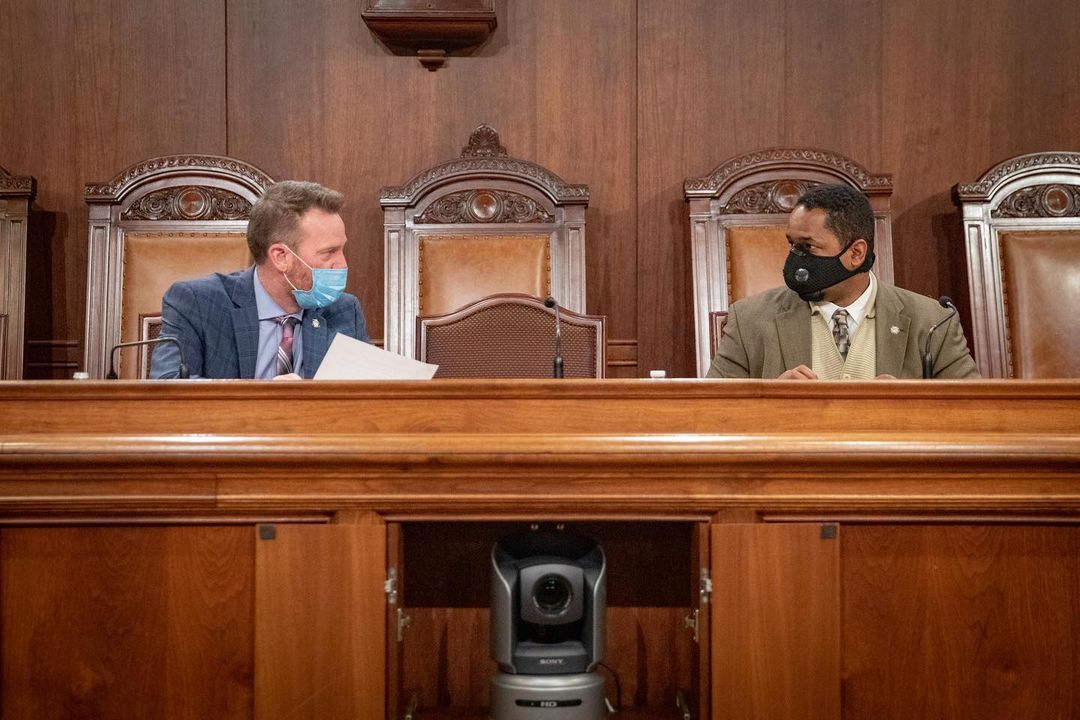
Credit: PA Senate Democratic Caucus
As Pennsylvania faces a potential multi-billion dollar budget hole, a Republican and Democratic state senator are introducing a bipartisan proposal to legalize and tax recreational cannabis.
Advertisements
The sponsors, senators Dan Laughlin, R-Erie, and Sharif Street, D-Philadelphia, cited shifting public attitudes, as well as the potential gain from a new crop for farmers, a fresh start for those with a possession arrest on their record, and a boast to the state’s bottom line.
“I pledged to never raise taxes when I ran for this seat, and I refuse to see a single tax raised on Pennsylvanians when an opportunity for new revenue to balance our state budget is right in front of us,” Laughlin said during a Wednesday news conference at the Capitol.
Under their plan, people age 21 and older could purchase marijuana., And, as is the case with cigarettes, marketing directed to children would be banned.
Advertisements
The plan also would allow state medical marijuana patients — but not recreational users — to grow their own cannabis at home.
The senators added that their plan would also expunge non-violent marijuana convictions, decriminalize weed up to a certain limit, and enable the state’s independent farmers to grow pot as a crop. They are already allowed to grow hemp, a less potent form of cannabis.
Advertisements
Licenses would also be given to “social and economic equity applicants,” according to a memo to Senate colleagues.
“We want to make sure this is not just a boon for the big guys,” Street said.
Exact language of the proposal still hasn’t been released.
Advertisements
As for revenue, Laughlin cited the state’s Independent Fiscal Office, a non-partisan policy analysis agency, to claim the state could bring in up to $1 billion a year in revenue.
Matt Knittel, the office’s executive director, said in an email that his agency had not officially researched the subject. Instead, the number Laughlin used was a ballpark estimate Knittel offered up last week in response to a question at a budget hearing.
Advertisements
In response, Knittel said that based on other states’ tax revenues, Pennsylvania could raise “somewhere between California and Colorado,” or between $400 million to $1 billion a year.
The proposal has the support of the Pennsylvania Cannabis Coalition, an industry group of medical cannabis growers, processors, sellers and researchers. Coalition Executive Director Meredith Buettner said the group was “ready to work” with lawmakers to develop a safe, beneficial outcome for the commonwealth.
Advertisements
It also excited grassroots cannabis advocates. Patrick Nightingale, president of the Pittsburgh chapter of NORML, a nationwide cannabis advocacy group, pointed to the legalization of home growth as a key feature.
Such a provision allows low-income patients who can’t afford Pennsylvania’s highly priced medical weed to save money on their medicine, he said.
Advertisements
And regardless of the specifics, seeing a Republican back the proposal was akin to hitting the jackpot, Nightingale argued.
“We understand it may not be the perfect bill cannabis activists want to see,” he said. But “the fact we’re having this conversation in earnest with our conservative friends and allies” could bring with it reform this year.
Laughlin first signaled support for legalization last year, and now fresh off reelection to a four-year term, he argued that supporting legalization was consistent with his, and his parties’ conservative values.
Advertisements
“Republicans stand for freedom, and I don’t know what is more Republican than this,” Laughlin said.
But other members of his party haven’t bought into the hype. Republican leadership in the General Assembly has consistently opposed legalizing it.
Advertisements
As recently as August 2020, House Majority Leader Kerry Benninghoff, R-Centre, has called legalization “utterly irresponsible.” Senate President Pro Tempore Jake Corman, R-Centre, has previously called it “reckless and irresponsible.”
As of Feb. 2021, Laughlin said Senate GOP leadership had at least given him the go ahead to pursue the issue. A spokesperson for Corman said he would let the committee process play out.
Jason Gottesman, a spokesperson for Benninghoff, pointed out that the state’s medical marijuana program, which Benninghoff voted for, passed just five years ago.
Advertisements
That program needs more time to research the effects of marijuana use before the General Assembly takes further action, he added.
Legalizing weed first started to appear on Harrisburg’s agenda when a statewide Democrat, former Auditor General Eugene DePasquale, signaled support in 2017. He was joined by newly elected Lt. Gov. John Fetterman in 2018. In late 2019, Gov. Tom Wolf, at first a skeptic, also backed legalization.
Public polling has shown majority support for legalization. Fetterman meanwhile conducted a non-scientific listening tour of the state to gauge support for legalization.
Advertisements
He found widespread anecdotal backing, with fall off only among some rural central Pennsylvania counties.
Decriminalization, which eliminates criminal penalties but prevents the legal sale of marijuana, had even broader support. It has also generated a little more support among Republicans in the past years. But Laughlin and Street didn’t think it was right to take a half measure.
“We don’t want to build a black market. We want to eliminate it,” Street said.
A bill just signed into law in neighboring New Jersey legalized recreational cannabis this week. New York, where Democrats control the executive and legislative branches, could be next.
Advertisements
So far, 14 states nationwide have legalized recreational marijuana.
Report a correction via email | Editorial standards and policies