


Credit: Petra Chesner Schlatter
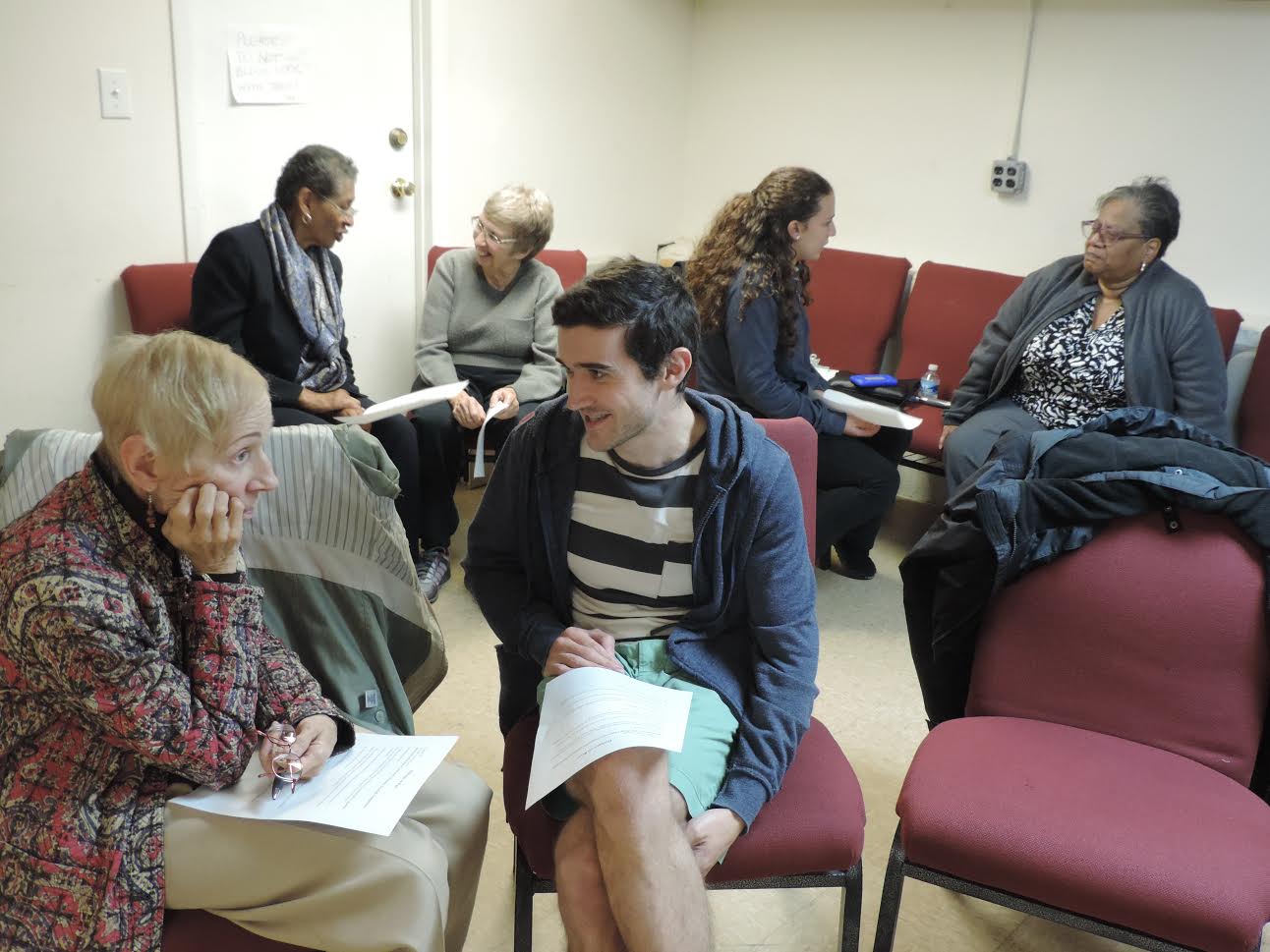
A diverse group of about 40 people discussed social change and justice at another Community Dialogue on Race on Oct. 24 at the multi-cultural St. Mark AME Zion Church in Newtown.
Barbara Simmons, executive director of The Peace Center (TPC), said, “Participants were urged deep listening of one another for both healing and identifying ways to help make our communities and our nation a safe and accepting place for everyone.”
Advertisements
TPC has been co-sponsoring the dialogues with Compassion Develops Community(CDC). The dialogues are part of TPC’s ongoing celebration of its 35th anniversary, “Speak Up For Peace.”
One of the key themes during one-on-one dialogues with two per group was the divisiveness in the country because of the current presidential election. Race relations were also discussed.
Rev. Sandra Reed, pastor at St. Mark’s and an African-American, said after the dialogue, “If we don’t know we’re hurting, we will never recognize we need healing. It is necessary that we examine ourselves. If we never examine ourselves, we’ll never know we’re hurting. Self-examination is critical to healing. We have to examine our thinking as well as our emotions.”
Advertisements
After the dialogue, Dennise Veasley, CDC leader, a member of St. Mark’s and an African-American, said, “The point that stands out the most is we have to speak out early when we find things are offensive because when we don’t speak out, it says that it’s okay. It becomes a habit to offend people. We have to stand up and speak out against injustice.”
Simmons agreed, “The salient points of the dialogue were that the community acknowledges that we need to speak up early on when someone is being offensive. We need to refrain from labeling. We need to be open minded in our conversations with people that differ from us, but yet honor our anger.”
Advertisements
She said it is important “that we all come from this place of trauma and fear. And therefore we need to develop empathy and language that recognizes that and to address that.
“We need to keep dialoguing,” Simmons continued. “We’re also arranging for these dialogues to happen in Bristol as well as Doylestown. This is going to be a long-term effort. We’re ready to do them all over.”
TPC and CDC have held numerous Dialogues on Race.
Advertisements
During the dialogue, people were asked to address various questions:
- When the election is over only the naming of the president will be apparent. How do we as a community begin to heal? What duties do we owe to our community?
- What can we do as a community to support one another in the face of hate?
- Do you believe America is at a point of no return, in terms of its citizens placing trust in our government, judicial and political systems?
Elizabeth Serkin, 77, a Quaker and a Pennswood Village resident, and Joyce Martone, 62, a member of St. Mark’s and a Langhorne resident, were among the pairs who discussed the answers to the questions.
Advertisements
Serkin, a sociologist, taught at Bucks County Community College.
She talked about healing in the community. She said the times we are living in are “really scary” and that “people are traumatized.
Advertisements
“I am much more concerned about a community that is split than I am about any of the candidates,” she said. “I look at what are the conditions that allowed this to happen. I look at after the Civil War when abuse of minorities got worse than ever.
“I don’t think this is going to go away,” Serkin continued. “It’s too much like Germany. It’s too much like every time a demagogue appears, I look at what are the conditions that made that happen and those conditions are still going to be there after the election.
Advertisements
She said healing has “to go beyond who you voted for. This is: ‘What is it about our community that allowed this split to happen?’”
“Hitler tried to kill my grandfather,” Serkin said. “We were refugees. We came over in November, 1939, which was the last passenger boat out of Europe. I feel pretty strongly about dictatorships and all the things that come with it like homophobia and racism. They’re so similar.”
Martone spoke of her personal experiences about diversity where she lives. “I am very fortunate where I live because we have diversity,” she said. “We’re a small community. Two houses down, there’s an African American couple, who are very loving. A few houses down there is an interracial couple. So, we’re very mixed.”
Advertisements
Her husband served in the Vietnam War. “He said if anyone wants to see a racial war end, go to war because he and his [comrades] had to be there for each other.”
Martone continued, “Healing the community is not easy because you have to realize where the people are coming from.”
Advertisements
The next Community Dialogue on Race will take place at Macedonia Baptist Church, 218 N. State Street, Newtown Borough on Wednesday, Nov. 16 at 7 p.m.
Another dialogue will be on Tuesday, Nov. 29 at 7 p.m. at Bristol Hope Assembly, 343 Hope Assembly, Bristol Borough.
For more information, visit www.thepeacecenter.org or call The Peace Center at 215-750-7220.

