


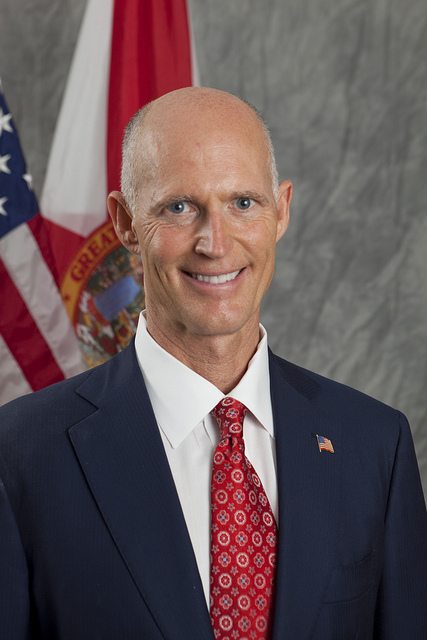
Credit: State of Florida
By Andrew Staub | PA Independent
Florida Gov. Rick Scott is planning a trip to Philadelphia in February, and he’s hoping to lure some Pennsylvania businesses back south with him.
Advertisements
His pitch so far has focused on differences in the states’ existing business tax climates, as well as policies and business mandates from Pennsylvania Governor-elect Tom Wolf that Scott said would be “heavy blows” to families in the Keystone State.
“I am leading a delegation to Philadelphia to send a message to all Pennsylvania job creators and families that we want you to keep more of the money you make because we understand it’s your money,” Scott said in a written statement announcing the visit.
Scott pointed to Pennsylvania’s flat 3.07 percent income tax and said Wolf “wants to raise it even higher.” The incoming governor has proposed raising the income tax and creating an exemption for low-income people, essentially to institute the type of progressive tax rate prohibited by the state constitution.
Advertisements
Wolf, a Democratic businessman and former state revenue secretary, has also proposed instituting mandated sick leave for some employers, a point of concern within the business community. He also favors a severance tax on the natural gas industry, which currently pays a local impact fee put in place under outgoing Gov. Tom Corbett.
Jeffrey Sheridan, a spokesman for Wolf, said the severance tax would be used to bolster education funding, while the income tax overhaul is designed to make the system more fair. It would not be so burdensome that it would to force businesses to flee, he said.
Advertisements
Plus, Sheridan said, Wolf favors lowering the corporate net income tax and has successfully rebuilt his family business twice.
“He knows how to create jobs. He knows what the business community needs to create jobs,” Sheridan said.
David Taylor, executive director of the Pennsylvania Manufacturers’ Association, said it remains to be seen whether any businesses will answer the Florida governor’s call. At the same time, Taylor said, competition among states is “very real.”
Advertisements
“It’s very revealing,” Taylor said of Scott’s business development mission, “but the truth is that these forces are at play all the time, and this is exceptional only in that the governor of a competitor state would do something so publicly.”
Texas Gov. Rick Perry, another Republican, has also tried similar strategies in past attempts to lure businesses from California, Illinois, Missouri and New York to his state.
Advertisements
Scott’s press office didn’t immediately return a message seeking further comment, but his announcement from last week outlined several reasons why he thinks business should follow him back to Florida. Much of it centered on the state’s business climate, which the Tax Foundation ranked fifth compared to Pennsylvania’s 24th-place ranking.
Florida has no individual income tax, or taxes on inheritance and capital stock. All of those exist in Pennsylvania, though the state has been phasing out its capital stock and franchise tax. Scott also noted Florida’s superior bond ratings.
Advertisements
Scott announced his visit on Friday. On Monday, Americans for Prosperity, a conservative political action group, said Pennsylvania has already lost $6 billion in wealth to Florida and urged state officials “to focus on policies that will encourage Pennsylvania businesses to stay here and make it easier for them to create jobs and opportunity.”
State Rep. Eli Evankovich, R-Westmoreland, chairs the House Manufacturing Caucus and said Pennsylvanians need to take Scott’s mission seriously.
Advertisements
Pennsylvania holds a competitive advantage with its proximity to large populations centers, vast energy resources and ample infrastructure, Evankovich said, but officials could nullify those perks by failing to curb cost drivers and succumbing to tax increases to help fix a projected budget deficit of nearly $2 billion.
“That gives Gov. Scott exactly what he needs to come into Pennsylvania and try to cherry pick our employers,” he said.
While a General Assembly with large Republican majorities could blunt Wolf’s agenda, the budget hole leaves open the possibility the new governor and state lawmakers will be forced to look for increased revenue somewhere and perhaps cease some of the business and corporate tax breaks seen under Corbett.
Advertisements
Lawmakers could still make the business climate better without impacting collections, such as taking steps to limit lawsuit abuse, Taylor said. Pennsylvania is still dealing with the “ghosts of 1991,” when the state heaped big tax increases on business while dealing with a budget deficit, he added.
“These have been mistakes of the past that we need to learn from and avoid,” Taylor said. “Even in the short term, if we can’t actively make things better, than the most important opportunity is to prevent things from getting worse.”

