




Credit: Bristol Township police
Bristol Township officials are using a collection agency to pursue drivers who fail to pay fines racked up from the municipality’s automated red-light enforcement cameras.
Advertisements
The Bristol Township Council voted last week to retain Municipal Collections of America Inc., known as MCOA, after a surge in unpaid citations from the township’s monitored intersections.
“We now are at the point where people are not paying,” Township Manager Randee Mazur said.
As part of the collection effort, delinquent drivers will face an additional $35 collection fee stacked on top of their initial $100 citation, with the added fee covering the cost of MCOA’s services, Mazur told LevittownNow.com.
Advertisements
Upcoming violation notices sent to motorists will include warnings regarding the additional fee if fines are not settled within the designated timeframe, the township manager said.
The red-light enforcement system covers two key intersections with a total of eight cameras installed and operated by Sensys Gatso.
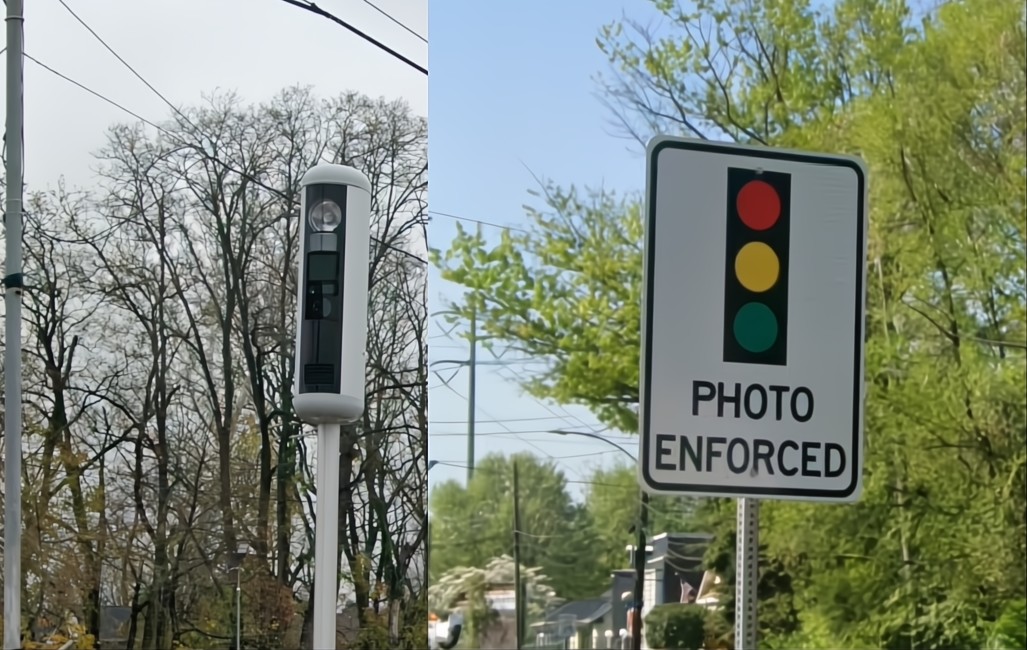
Credit: Google Maps
Advertisements
The cameras monitor the intersections of Route 13 and Green Lane, Route 13 and Edgely Road, Veterans Highway (Route 413) and Wharton Road/Old Rodgers Road, and Veterans Highway and Western Avenue.
The agreement for collection of overdue violation fees is similar to a setup Bristol Township already uses on to recover unpaid sewer bills, Mazur said.
Sensys Gatso handles the installation, maintenance, and operation of the camera hardware, as well as collecting initial payments directly from violators.
Advertisements
The vendor forwards the funds to Bristol Township. In turn, the township makes monthly payments back to Sensys Gatso and distributes annual payments to PennDOT, which directs the net revenue into a statewide transportation grant program.
Officials have said all expenses related to the camera operations are covered through the revenue generated by the violations.
Advertisements
With eight camera approaches in operation, annual operating costs are projected at $579,223. The expenses cover vendor fees to Sensys Gatso, police officer labor for reviewing and enforcing violations, legal fees, civilian and finance staff time, and administrative costs like postage and stationery.
Officials anticipate the camera systems will generate $2.8 million in 2026.
Advertisements
A township budget document said growing driver awareness of the cameras is expected to lower overall revenue over time.
Township police have told the public that the aim of the automated enforcement is to improve safety along busy roadways.
Advertisements
A 2016 study by the Insurance Institute for Highway Safety, a nonprofit group funded by auto insurance companies, found that automated enforcement programs reduced the overall rate of fatal crashes at signalized intersections by 14 percent.
However, the automated enforcement programs nationwide have drawn criticism.
State law allows automated red-light cameras in municipalities that have a population of at least 20,000, an accredited police department, and location within an eligible county.
Advertisements
In Bucks County, Bensalem Township and Warrington Township operate red-light camera systems.
Philadelphia was the first municipality in the state to use the technology, bringing in $32 million from its program in 2024, according to Lehigh Valley Public Media.

