
By Peter Hall | Pennsylvania Capital-Star
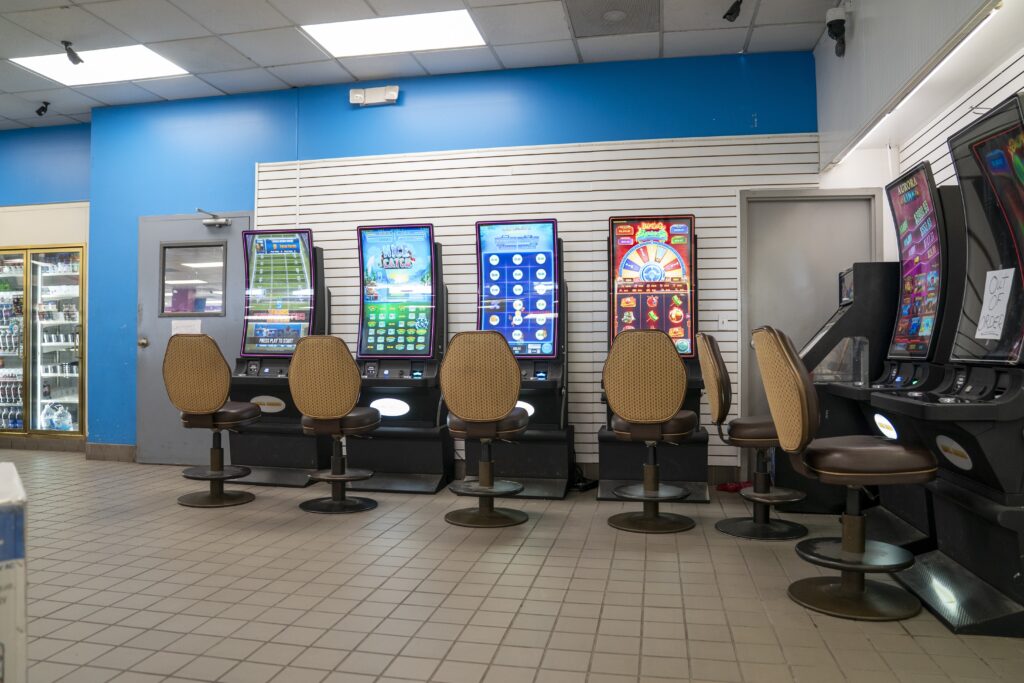
Credit: Jessica Kourkounis for the Pennsylvania Capital-Star
Skill games are unlawful under Pennsylvania’s Gaming Act and Crimes Code, the state Supreme Court ruled Monday.
Advertisements
The decision strikes down what the commonwealth’s highest court called a pair of “deeply flawed” lower court rulings that allowed the slot-machine-like gambling devices to spread across Pennsylvania in a legal gray area beyond the reach of gaming authorities and law enforcement.
“Thriving therein, the devices now may be found not only in taverns, restaurants, and social clubs, but also in mini-marts, gas stations, grocery stores, laundromats, pizza parlors, and various other establishments throughout Pennsylvania — even some dedicated solely to the purpose,” Justice David Wecht wrote in the 66-page decision for the 4-2 majority.
Since the intermediate Commonwealth Court ruled in 2023 that skill games are not slot machines as defined by state law, the devices have been the subject of legislation seeking to outlaw them altogether, with lawmakers noting detrimental effects including increased crime and the exposure of children to gambling.
Advertisements
Pace-O-Matic, the Georgia-based company that produces the software in Pennsylvania Skill games, said it is disappointed in the decision and “strongly believes” the decision doesn’t reflect the facts that led to a string of favorable decisions for the company.
“Sadly, this opinion will have far-reaching consequences, with more than 10,000 Pennsylvania small businesses and fraternal clubs becoming the real victims,” the company said in a statement.
Advertisements
They face the prospect of giving up the games and losing an important source of revenue or enduring excessive regulation and “crippling taxation,” which would have the same result.
State Attorney General Dave Sunday issued a statement calling the decision a “significant victory for consumers, taxpayers and the rule of law in Pennsylvania.”
“The Supreme Court recognized what our office has argued from the beginning – these machines operate as gambling devices and cannot legally exist without the same oversight, regulation and accountability as other forms of legalized gaming in the Commonwealth. Pennsylvanians deserve protections that ensure games are fair, transparent and operated within the bounds of the law,” Sunday said.
Advertisements
The attorney general’s office, which estimates there are 70,000 skill machines in operation in the commonwealth, argued that embedding an element of so-called skill into the games does not exempt the devices from Pennsylvania gambling laws.
The decision handed down late Monday actually resolves two cases: One in which the Gaming Act’s definition of slot machine was at issue; and the second in which the seizure of three skill game machines, cash and receipts from a Harrisburg area business was overturned.
Advertisements
State policymakers, including Gov. Josh Shapiro, have looked to the skill game industry as a potential source of tax revenue, proposing to legitimize and tax the proceeds of the machines at rates similar to those imposed on casinos. Details of those proposals proved a sticking point in recent budget negotiations.
Wecht noted that many placed “reasonable reliance” on the Commonwealth Court’s decisions.
Advertisements
“We are further mindful of the potential disturbance that our correction of the prevailing case law may cause to business owners and other good-faith participants in the industry,” the lead opinion says.
For that reason, the court stayed the decision for four months, during which no law enforcement agency is to take action against owners and operators of the machines.
Advertisements
He also wrote that the court reached its decision as a result of interpreting existing statutes and that the General Assembly could take whatever action it deems appropriate.
Wecht took the unusual step of stating the court’s decision is not an endorsement or based on any policy position regarding the machines, adding that manifesting the public policy of the commonwealth is the legislature’s purview, not the judiciary’s.
“To put it more plainly, how one feels about access to ‘skill games’ or other types of slot machine — or about the broader legalization and normalization of gambling in our society, for that matter — is irrelevant. This is, rather, a matter of straightforward application of existing statutory law,” Wecht said.
Advertisements
He noted the General Assembly amended the Gaming Act’s definition of “slot machine” to include “skill slot machine” as a device in which the skill of the player rather than the element of chance is the main factor in the outcome. It also defined a hybrid in which the combination of skill and chance determine the outcome.
Lawyers for Pace-O-Matic, the predominant distributor of skill game software, argued that the company’s games could be won every time by a skillful player.
Advertisements
Wecht said the definition of skill slot machines makes “abundantly clear” the skill element of the machines is not legally sufficient.
“That is to say, as it concerns their unregulated operation in unlicensed facilities throughout Pennsylvania, it is not this Court that declares “skill games” to be unlawful. Rather, it is the General Assembly that did so nearly a decade ago,” he said.
Justice Christine Donohue issued a separate opinion concurring in the result of the majority decision. Justice Kevin Brobson wrote a concurring and dissenting opinion, joined by Justice Sallie Mundy, in which he agreed that the machines are covered by the Crimes Code but not the Gaming Act.
Justice Kevin Dougherty did not participate in the decision.
Pennsylvania Capital-Star is part of States Newsroom, a nonprofit news network supported by grants and a coalition of donors as a 501c(3) public charity. Pennsylvania Capital-Star maintains editorial independence. Contact Editor Tim Lambert for questions: info@penncapital-star.com.