


By Nick Field | Pennsylvania Capital-Star
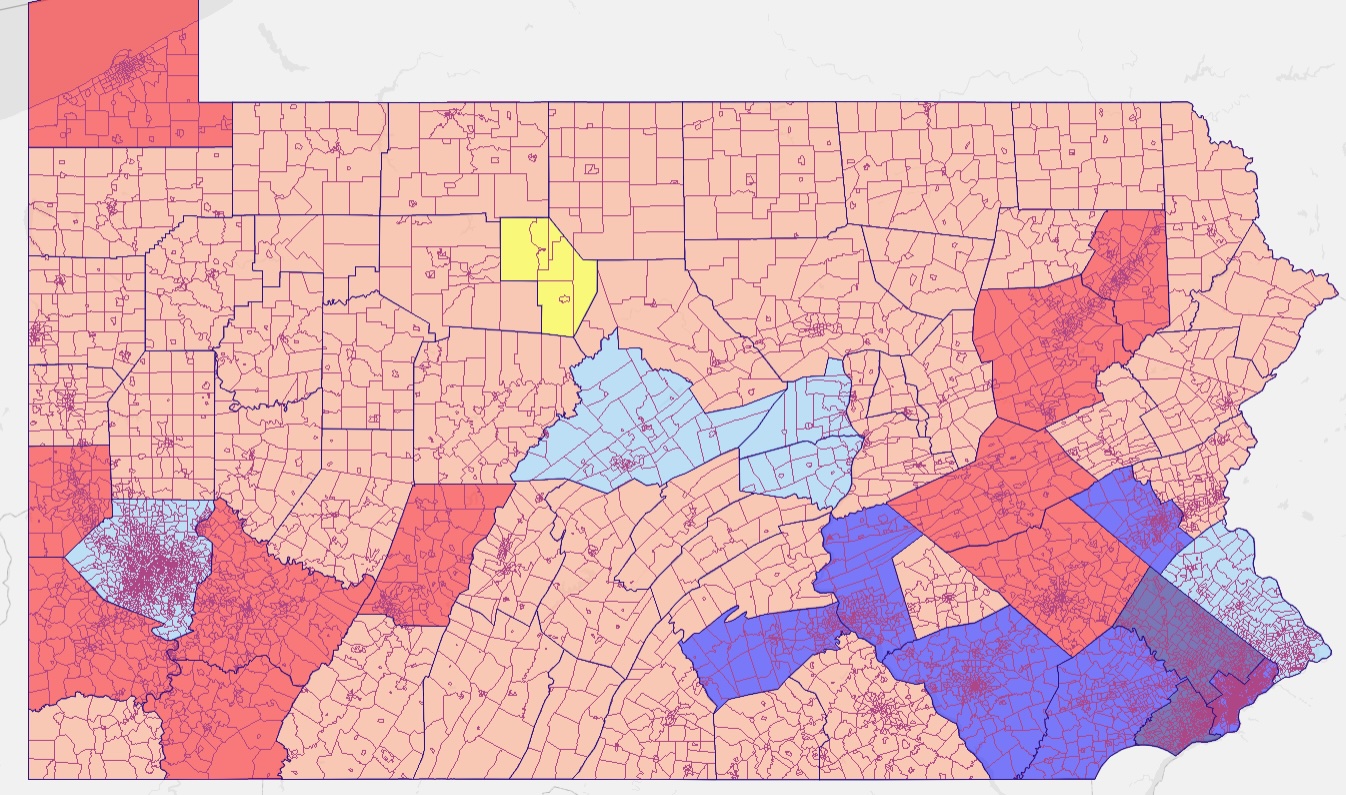
Map by Nick Field via Dave’s Redistricting
The momentum is officially shifting when it comes to which party Pennsylvanians are aligning with when registering to vote.
Advertisements
Coming off their 2024 triumph, Pennsylvania Republicans continued to make gains in statewide voter registrations through the spring and summer of 2025. But last October, the tide suddenly began to turn and now Democrats are beginning to pick up ground. This trend almost exactly replicates what happened after the 2016 election, when the GOP started to lose steam in late 2017 and early 2018.
At last October’s registration deadline, the Democratic lead in the commonwealth stood at only 170,608, but today that advantage has moved to 188,381. While this is still far behind the 281,091 edge Dems held on the eve of the 2024 election, it represents the best period for the party in the commonwealth since the immediate aftermath of the Dobbs decision in late summer 2022. The last time there was sustained success for Democrats in the state was during President Joe Biden’s Spring 2021 Vaccination Honeymoon, when his numbers hit all-time highs.
So where exactly are these Democratic gains coming from, and where is the GOP still holding their ground? Well, let’s dig into the numbers to find out.
Advertisements
A quick note: I explore our changing voter trends by tracking the gains one party accumulated in registrations over the other party. For example, R+500 means that the Republican Party gained a net 500 more registered voters in that county than the Democratic Party did over this period, while D+500 indicates the opposite.
Central
Blair: R+131
Bradford: R+445
Cameron: R+0
Centre: D+338
Clearfield: R+665
Clinton: R+220
Columbia: R+262
Elk: R+295
Huntingdon: R+222
Juniata: R+78
Lycoming: R+84
McKean: R+211
Mifflin: R+218
Montour: R+58
Northumberland: R+326
Potter: R+7
Snyder: D+31
Sullivan: R+65
Tioga: R+283
Union: D+121
One of the final surprises of 2024 was Republican registrants overtaking Democrats in Centre County, home to Penn State University. Since the mid-2000s, young voters have overwhelmingly tended to favor Democrats, yet President Donald Trump was able to improve upon his prior performances with them, particularly among young men. Over the course of the last year-and-a-half, however, Trump’s numbers with those voters have plummeted. Not coincidentally, Democrats were able to post gains not only in Centre, but in neighboring Union County (home to Bucknell University) and Snyder County (home to Susquehanna University) as well.
Advertisements
Northeast
Carbon: R+588
Lackawanna: R+1,346
Luzerne: R+1,905
Monroe: R+581
Pike: R+510
Schuylkill: R+1,167
Susquehanna: R+262
Wayne: R+408
Wyoming: R+34
In 2024, Trump saw his biggest gains in this corner of the commonwealth, to the point that Rep. Rob Bresnahan was able to ride the president’s coattails to victory. In 2026, despite Bresnahan’s controversial stock trades, the GOP continues to gain strength along the Scranton/Wilkes-Barre corridor. That’s tough news for Scranton Mayor Paige Cognetti, who is aiming to flip the seat back to blue in November. The one silver lining for her is that Democrats have improved their numbers in Monroe County since October, highlighting one potential area of growth.
Northwest
Clarion: R+266
Crawford: R+383
Erie: R+1,115
Forest: R+45
Jefferson: R+149
Mercer: R+646
Venango: R+322
Warren: R+197
Advertisements
The other northern corner of the commonwealth is getting redder as well, since the improving Democratic environment has yet to impact the all-important bellwether county of Erie. The state’s only lakeside county has supported the statewide winner in 19 out of the last 20 presidential elections, so it’s one to keep a close eye on.
South central
Adams: R+403
Bedford: R+201
Cumberland: D+1,098
Dauphin: D+1,820
Franklin: R+196
Fulton: R+157
Lancaster: D+1,450
Lebanon: R+82
Perry: R+140
York: R+70
For years now, I’ve noted that south central Pennsylvania is a prime area for Democratic growth, and the party is striking paydirt in Cumberland, Dauphin and Lancaster counties. Moreover, the GOP received disappointing results in York County, where they enjoy their largest advantage statewide. Such numbers are a warning sign for Congressman Scott Perry, who’s arguably the most endangered incumbent this year among the Pennsylvania delegation.
Advertisements
Southeast
Berks: R+1,013
Bucks: D+607
Chester: D+3,222
Delaware: D+5,355
Lehigh: D+1,173
Montgomery: D+5,633
Northampton: R+668
Philadelphia: D+3,937
Once again, the Philadelphia suburbs are powering a momentum shift towards the Democrats, as they previously did from 2018 to 2020. Particularly notable here is the turnaround in pivotal Bucks County, where Republicans surpassing Dems in registrations mid-way through 2024 was an indicator that Trump would be the first GOP presidential nominee to win Bucks in 36 years. The county is represented by Brian Fitzpatrick, probably the most entrenched of the four Democratic congressional targets, so any effort to unseat him will require continued improvement for Democrats in Bucks.
The fourth GOP House seat at risk is PA-7, which contains Lehigh and Northampton Counties (as well as Carbon and a slice of Monroe). Incumbent Ryan Mackenzie can’t be thrilled by those numbers in Lehigh, to say nothing of the fact that Democrats have gained ground in Northampton County since last fall’s turnaround.
Advertisements
Southwest
Allegheny: D+931
Armstrong: R+382
Beaver: R+1,335
Butler: R+638
Cambria: R+1,216
Fayette: R+1,660
Greene: R+664
Indiana: R+599
Lawrence: R+765
Somerset: R+620
Washington: R+1,841
Westmoreland: R+2,495
The richest vein for Republican gains remains the Appalachian southwest, particularly the populous counties of Beaver, Fayette, Washington and Westmoreland. Ancestral Democrats here continue to defect to the Grand Old Party, a movement that’s still running strong decades in. The only silver lining for Democrats in this region is that their post-2024 slide in Allegheny County appears to be over.
Advertisements
Who deserves the credit and what does it mean for November?
How can we account for this swift back towards the Democrats? Well, much of it is likely the natural ebb and flow of national politics. Since incumbent presidents tend to see their party suffer losses during midterm elections, Dems are picking up steam as Trump’s approval ratings continue to drop.
On the other hand, supporters of Pennsylvania Democratic Party Chair Eugene DePasquale are eager to point out that this trend of voter registration gains began just a month after he took over in September 2025. Another local official who may deserve some credit is Gov. Josh Shapiro. After all, DePasquale is a close ally of the governor’s and his ascension was seen as a sign that Shapiro is taking on a more active role in the state party. To that point, at around this same time, Shapiro donated $250,000 to the state party, while one of his top strategists was hired as their new executive director.
Advertisements
Ultimately, Pennsylvania Democrats are hopeful that Shapiro’s coattails this November are strong enough to flip the state Senate, as well as those four GOP Congressional seats mentioned above. Although it’s still early, the party enters this summer the most optimistic they’ve been since probably 2020. Conversely, Pennsylvania Republicans in competitive districts must plan to battle uphill for the rest of the year.

