



Middletown Township has proposed a 2026 budget with tax increases to cover spending.
The proposed 2026 spending plan totals $53.1 million in operational expenditures and an additional $5.1 million for capital projects.
The proposed financial plan calls for a net increase of 6.08 mills in real estate tax across various funds and a doubling of the earned income tax (EIT) rate.
Advertisements
Despite the proposed tax increases, township staff reduced expenses by approximately $1 million from the 2025 budget and denied another $1 million in departmental requests for 2026, officials said.
“We are at a crossroads where we have the very real challenge of making a decision between continuing and maybe even improving the level of service that we are providing to our residents and keeping revenues and taxes flat,” Supervisor Chairperson Mike Ksiazek said.
Without additional revenue, Township Manager Eden Ratliff warned the municipality would face significant service cuts, including staff layoffs across all departments, reduced police response beyond emergency response, and the ending of maintenance for 800 acres of parks and green spaces, including the greenbelts in Levittown.
Advertisements
“We would be looking at cutting services,” Ratliff said. “We would start by getting rid of the proactive stuff.”
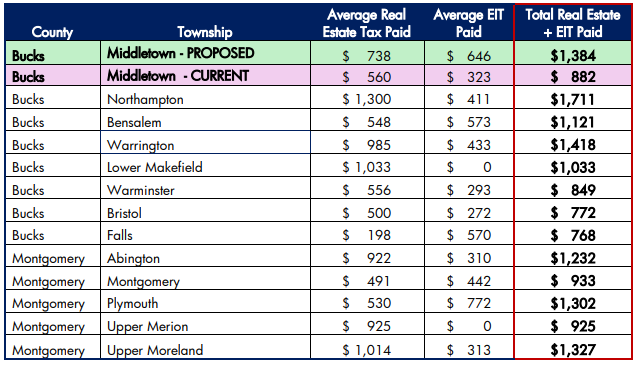
According to the township, the average homeowner pays $738 in real estate taxes to the municipality. The proposed real estate tax hike comes to roughly $180 extra per year.
Under the proposal, the EIT rate would go from the current 0.5 percent to 1.0 percent.
Advertisements
The change, if approved by the Middletown Township Board of Supervisors, is expected to generate an extra $6.2 million in 2026, bringing the total EIT revenue to $16 million. By 2027, the EIT revenue is expected to nearly double to roughly $19 million annually.

The average Middletown Township resident pays approximately $323 per year in EIT. Doubling the rate would be an increase of approximately $323 per taxpayer per year.
Between the proposed real estate and EIT rates, Middletown Township residents would pay a tax rate similar to residents in Abington, Upper Moreland, and Plymouth townships in Montgomery County. They would pay more than residents in Bensalem Township, Bristol Township, Falls Township, and Warminster Township, but at a lower rate than Northampton and Warrington townships.
Advertisements
The total increase, including real estate tax and the EIT, would be 57 percent, according to the proposed budget.
Ratliff said the tax increases are needed to end years of growing structural deficits, restore depleted reserves, and launch the municipality’s largest ever investment in aging infrastructure.
The 2025 budget carried a $2.8 million structural deficit, a figure that historically tends to grow by roughly $1 million each year, Ratliff said.
Advertisements
The township manager, who started in summer, stated the 46,000-resident township could no longer absorb the imbalance by using its reserves.

“The proposed 2026 Budget contemplates a tax increase to fund the government that has been balancing its operations by spending down its fund balance for the past several budget years,” Ratliff wrote in his budget proposal.
The township manager issued a stark warning regarding the consequences of failing to secure the necessary revenue: “Without a tax increase, significant reductions in service—nearly 20% of all staff—will be necessary to balance the budget.”
Advertisements
The township’s fund balance policy requires the General Fund to keep a reserve equivalent to at least 25 percent of annual operating costs. At the end of 2025, the General Fund balance is projected to be at the minimum level permitted by this policy.
“If we do not significantly reduce cost or add revenue into the budget going 2026, we will be in violation of that policy,” Ratliff explained.
Advertisements
In the budget proposal, officials said the EIT rate at 0.5 percent is tied for the second-lowest among Bucks County townships. Six municipalities bordering Middletown already levy a 1 percent EIT.
The proposal emphasizes that the increase would be “minimally impactful to retirees as forms of retirement income are generally not subject to the EIT,” officials said.
Advertisements
For Middletown Township residents who already work in a municipality with a higher EIT rate, “they are typically paying 1.0% and will not experience a tax increase, but rather will now see their tax dollars invested in their own community.”

With the proposed change, the EIT would become the largest source of revenue for the General Fund, accounting for 51.8 percent of its income
Advertisements
In addition to the EIT increase, the budget proposes a net total increase of 6.08 mills real estate tax, which will bring the combined township millage rate to 25.105 mills.
Assistant Township Manager Nick Valla said the Neshaminy School District could put a referendum to voters to attempt to claim half of the township’s 1 percent EIT. However, residents would have to vote on it and the township has considered that possibility.
Advertisements
The proposed increased marks the first substantial increase to the real estate tax since 2010. A small tax increase was made in 2024 for fire protection, a fee for stormwater was implemented in 2025, and the waste fee for trash and recycling hauling increased by $75 at the start of the year.
The 6.08 mill increase is expected to generate approximately $3.16 million in new revenue specifically earmarked for targeted services, including fire and ambulance services.
Advertisements
The budget document noted that three-quarters of the proposed real estate tax increase is dedicated to fire protection services, which has been “the single fastest-growing service area in the township as career firefighters are hired to offset the decline in volunteerism.”
Citing a dramatic example of tax base erosion, the budget pointed out that the combined taxable value of parcels making up the Oxford Valley Mall has fallen by 78 percent since 2009. The value went from $18,210,060 to $4,110,340 in 2025.

The reduction in value of the mall property resulted in more than $500,000 in lost real estate tax revenue to the township alone during that period.
The budget puts 62.4 percent of every dollar, including pensions and post-retirement medical benefits, to the police department and connected retirement obligations.

Advertisements
While township staffing has remained relatively steady in recent years, the township is looking to add five full-time equipment operators focused on expanded stormwater maintenance operations to Public works, adding one fire services lieutenant, making a part-time information technology job full-time to focus on cybersecurity, and hiring a full-time township engineer to reduce outside spending for engineering.
The township, per contract agreements, will see wages increase for unionized employees, according to the proposed budget.
To support the volunteer fire service, the budget proposes increasing the annual volunteer stipend from $250 to $599 per volunteer per year. Furthermore, the existing tax credit program is proposed for expansion from a maximum of $500 to a 100 percent credit covering both real estate and EIT for active volunteer firefighters.
The new funding strategy is tied to a ramp-up of public works projects as part of the $5.13 million Capital Improvement Plan.
The township plans to pave nine miles of township-owned roadways in 2026, which is a fourfold increase over the 2025 budgeted amount. The road paving project is budgeted for $2 million through the Highway Aid Fund.

Accessible curb ramps will be replaced at three and a half times the current rate, putting the township on a schedule to complete non-compliant replacements by 2035. The increased pace is expected to complete nearly 80 ramps in 2026.
Through the new Stormwater Fund, the budget contemplates replacing three times as many stormwater inlets in 2026 compared to the previous year. The Stormwater Fund itself supports a total capital project budget of more than $1.76 million for the year.
Advertisements
The Road Machinery Fund accounts for $927,500 in new heavy and light equipment, including two dump trucks, a street sweeper, an excavator, two zero-turn mowers, and one pickup truck.
The budget also has funds for longterm planning, including a feasibility study for the Middletown Country Club, the township-owned golf course. The current lease for the property expires in December 2028, and the study is designed to “evaluate all possible options for the property once the lease expires.”
The township plans to maintain its $40 million investment fund, which came from the 2002 sale of its water system. Investment revenue from the fund has been used to contribute to the municipality’s spending.
Supervisor Dawn Quirple praised the budget team’s efforts while acknowledging the difficulty of the decision.
“We’ve looked at different ways that we could make this work without, with the least amount of harmful effects for the community,” Quirple said.
Supervisor Dana Kane stated she appreciated the township staff for being transparent throughout the budget process. She added that it is tough to propose tax increases, cuts, or do a hybrid of the two, but she noted one of the options is needed to fix the structural deficit.
The voted to advertise the proposed budget for public inspection and will vote on it at the Dec. 15 meeting.
Ratliff encouraged residents to review the complete budget document.
“Please read this budget book from front to back,” Ratliff said. “We wrote every word in there intentionally.”
A public town hall meeting on the budget is scheduled for Dec. 4 at 7 p.m. at the Middletown Township Municipal Center at 3 Municipal Way.
Advertisement

Meet Your Canna Coach: Personalized Guidance, Free for You!

Canna Remedies: Your Go-To Accessible and Convenient Dispensary
Shop Now: cannaremediesnj.com/shop
Report a correction via email | Editorial standards and policies