Credit: Tom Sofield/LevittownNow.com
Bristol Borough resident and educator Bill Pezza has released his latest book, “The Liberators.”
Pezza has released a series of historical novels set against the backdrop of Bristol Borough and American history.
Advertisements
The former borough councilmember, high school teacher, and community college history professor currently heads Bristol Borough: Raising the Bar.
“The Liberators” takes place in Bristol during the 1850s, spanning from the passage of the Fugitive Slave Law in 1850 to Abraham Lincoln’s election in 1860. The novel follows teenager Sam Spencer, who lives a double life working in his family’s Market Street General Store by day while helping his abolitionist parents smuggle fugitive slaves through the store’s backroom to canal barges bound for safety by night.
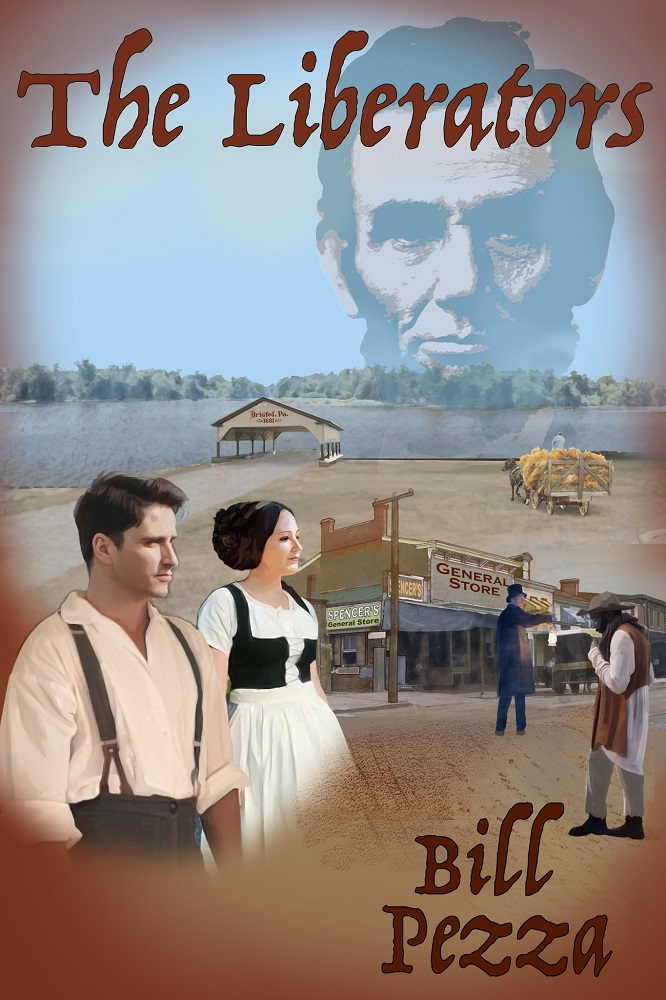
“I’ve always told my students there are three decades in American history that are really worthy of people’s attention because of the tumultuous nature of the time,” Pezza said. “The second is the decade of the 1850s because there’s just a steady drumbeat of polarization over the issue of slavery.”
Advertisements
The story centers on the moral conflicts faced by ordinary citizens when the Fugitive Slave Law required not only bounty hunters to pursue runaway slaves in the North, but also mandated that citizens assist them. Breaking this law carried penalties of fines and imprisonment.
“The Fugitive Slave act really put a face on the issue of slavery in the North,” Pezza said. “For the first time, people were seeing alleged runaway slaves captured, shackled, put in chains and paraded through the streets until they’re sent home.”
Advertisements
The novel’s protagonists, Sam Spencer and his love interest Abigail, become dedicated abolitionists whose marriage represents both romance and shared commitment to helping runaway slaves. Their Underground Railroad operations use Sam’s General Store on Market Street as a stop, with slaves then transported via canal barges heading north to Easton and eventually toward the New York border.
“The barges come south with coal and whatnot from the northern counties of the state, and then they head back and the slaves would be hidden in the barge to take back north,” Pezza explained.
The story incorporates real historical events as its foundation, including the release of Harriet Beecher Stowe’s “Uncle Tom’s Cabin,” John Brown’s activities in Kansas and Harper’s Ferry, and Stephen Douglas’s Kansas-Nebraska Act.
Advertisements
Pezza used the events to create authentic historical context.
“You use real historic events as a crutch,” he said. “They just fall one after another. So the people in town are reading the newspaper, they’re getting a telegraph, they’re experiencing that suspense.”
Advertisements
The novel features several area locations, including scenes at the Friends Meeting House on Market Street, the former Borough Hall on Market Street, and recreational activities at Silver Lake and Burlington Island. The story also incorporates the Farmers National Bank building on Radcliffe Street, which existed during the book’s timeframe.
A significant element involves the conflict between Sam and Bristol’s mayor, who prioritizes preserving the Union over addressing slavery concerns.
Advertisements
“He couldn’t care less about the issue of slavery. He wants the union to be preserved,” Pezza explained. “And he believes it’s his responsibility to enforce the law, to enforce the Fugitive Slave act once it was passed.”
The Quaker influence in Bristol Borough and Bucks County plays an important role in the narrative. Several scenes take place at the Friends Meeting House, where the young protagonists befriend a Quaker lawyer who tutors them on law and matters of conscience.
Advertisements
“He tutors them on the law. He tutors them about matters of conscience. He tries to tutor them on non violence,” Pezza said. However, he noted that the protagonist sometimes must resort to physical violence to protect others.
Pezza researched for the book using several sources, including Pat Mervine’s work on slavery and abolition in Bucks County.
Pezza noted that much of the character development requires imagination. His approach involves creating “characters who are hopefully engaging, likable and have a conscience” and following “their inner turmoil as they decide how much are we going to invest ourselves, how much are we going to stick our necks out to help these people in need.”
Advertisements
The author sees contemporary relevance in the historical themes.
“People, regardless of the era, and especially now, and especially then, were challenged and are challenged by matters of conscience, by matters of do I agree with my government? Do I disagree with it? Should I stand up for those who are not able to stand up for themselves?”
Advertisements
“The Liberators” represents Pezza’s sixth work of fiction, which include “Till the Boys Come Home,” “Anna’s Boys,” “Stealing Tomatoes,” “Homegrown,” and “Lost Time.” He also authored a nonfiction work called “How Bristol Won And Will Keep Winning.”
Pezza will host a free book launch party Tuesday, Nov. 11, at the Itri Event Space at 308 Mill Street starting at 6:30 p.m. The event will feature author-signed copies and character portrayals by Keith Baker, Jo Twiss, John Roach, and Dennis and Jeanine McGee.
Advertisement

Meet Your Canna Coach: Personalized Guidance, Free for You!
Canna Remedies: Your Go-To Accessible and Convenient Dispensary
Shop Now: cannaremediesnj.com/shop
Advertisements
Report a correction via email | Editorial standards and policies