


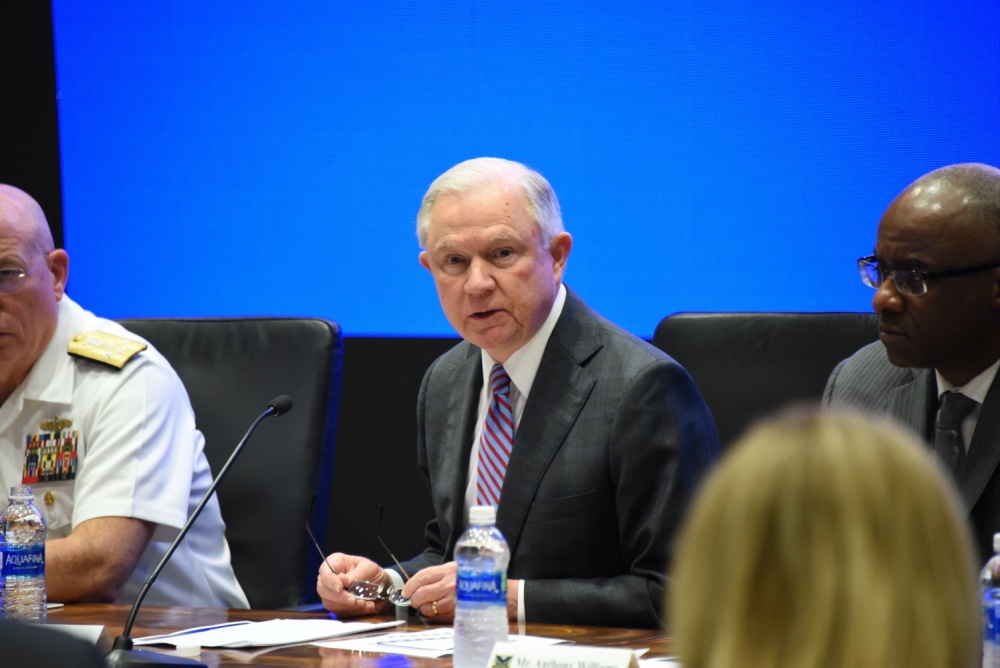
Credit: Petty Officer 2nd Class Jonathan Lally/U.S. Southern Command
Federal prosecutors were sent guidance Wednesday from U.S. Attorney General Jeff Sessions on pursuing capital punishment for drug-related crimes.
The memo from Sessions, the nation’s top law enforcement official, was sent to U.S. Attorneys across the country following President Donald Trump’s announcement this week that law enforcement must increase their “toughness” on punishing drug dealers, including use of capital punishment.
Advertisements
“This isn’t about nice anymore,” Trump told a crowd in Manchester, New Hampshire. “This is about winning a very, very tough problem and if we don’t get very tough on these dealers it’s not going to happen, folks.”
Federal law already allows prosecutors to pursue a penalty of death for homicides committed during drug-related activities. A second provision noted that capital punishment could be used for defendants accused of trafficking large amounts of drugs. However, Robert Durham, executive director of the Death Penalty Information Center, told PBS Frontline the provision has not been used since it was enacted during Bill Clinton’s administration.
“I don’t think there’s any reason to believe that attempting to revive this policy and use it more effectively will be any more successful,” Cornell Law School Professor John H. Blume told Complex.com.
Advertisements
“I don’t think people out there who sell drugs are worried about, ‘Am I going to get the death penalty?’”
Below is Sessions’ memo to U.S. Attorneys:
The opioid epidemic has inflicted an unprecedented toll of addiction, suffering, and death on communities throughout our nation. Drug overdoses, including overdoses caused by the lethal substance fentanyl and its analogues, killed more than 64,000 Americans in 2016 and now rank as the leading cause of death for Americans under 50. In the face of all of this death, we cannot continue with business as usual.
Drug traffickers, transnational criminal organizations, and violent street gangs all contribute substantially to this scourge. To combat this deadly epidemic, federal prosecutors must consider every lawful tool at their disposal. This includes designating an opioid coordinator in every district, fully utilizing the data analysis of the Opioid Fraud and Abuse Detection Unit, as well as using criminal and civil remedies available under federal law to hold opioid manufacturers and distributors accountable for unlawful practices.
In addition, this should also include the pursuit of capital punishment in appropriate cases. Congress has passed several statutes that provide the Department with the ability to seek capital punishment for certain drug-related crimes. Among these are statutes that punish certain racketeering activities (18 U.S.C. § 1959); the use of a firearm resulting in death during a drug trafficking crime (18 U.S.C. § 924(j)); murder in furtherance of a continuing criminal enterprise (21 U.S.C. § 848(e)); and dealing in extremely large quantities of drugs (18 U.S.C. § 3591(b)(1)). I strongly encourage federal prosecutors to use these statutes, when appropriate, to aid in our continuing fight against drug trafficking and the destruction it causes in our nation.


