


By Andrew Staub | PA Independent
Pennsylvania has doled out $5 billion through a grant program known as the Redevelopment Assistance Capital Program since it started in the 1980s, largely with hopes to spur job creation.
Advertisements
It’s the type of money that can lead to splashy announcements — like the news of $3 million going to Urban Outfitters to help install a solar array, or another $3 million being used to help transform a vacant halfway house in Pittsburgh into an upscale 120-room hotel.
But Adam Millsap, a research fellow for the State and Policy Project at the Mercatus Center, a free-market think tank based at George Mason University in Virginia, recently studied the program and said there are plenty of unseen effects tied to the grant program. And they go beyond gaudy job-creation numbers thrown out at press events.
Here are a few things to know about the program:
Advertisements
The program drove minimal job creation, but unseen effects could be damaging
Follow the trail from the footnotes in Millsap’s research, and you’ll eventually find the story of Good Samaritan Hospital in Lebanon receiving a $3 million RACP grant to fund a new cancer care facility.
Advertisements
That sounds like great news, except another competing facility, the Lebanon Valley Cancer Center, already offered those types of services — and one of its officials told ABC 27 that if the new center materialized, LVCC would be doomed. It also placed the LVCC in the awkward position of subsidizing its competitor through taxpayer-backed grants.
Most people don’t often draw the connection that one business’ grant could actually be the demise of another, Millsap said. Yet, that is among the unseen consequences that can occur when the government distorts the marketplace by picking who gets subsidies and who doesn’t, he said.
Other unseen effects include cutbacks, laid-off workers or reduced hours for businesses that don’t get the grant funding. In some cases, a business may just decide not to hire, Millsap said.
Advertisements
“All of these unseen effects are harder to quantify, so people just tend to ignore them,” Millsap said.
He did find that RACP generated some employment at the county level, not surprising considering the state is throwing around millions of dollars, Millsap said. However, he found the gross effect was small and potentially nullified as more funds driven into one county sometimes could come at the expense of economic activity in another.
Advertisements
Plus, because the program is funded through borrowing that eventually must be repaid, taxpayers ultimately will end up paying the tab years down the road, he said.
“Really, it’s kind of just moving economic activity around,” Millsap said.
Advertisements
Most of the money goes to two places, but it makes sense why it happens that way
Pennsylvania is comprised of 67 counties, but almost half of all RACP funding from 1986 to 2014 was funneled into Philadelphia County, which is coterminous with the City of Philadelphia and Allegheny County, where Pittsburgh is the county seat.
Advertisements

While those are the two most populous counties, they make up just 25 percent of Pennsylvania’s total population, meaning they receive a disproportionate amount of RACP funding. If the goal is to increase the employment across Pennsylvania, it doesn’t necessarily make sense to have most of the money go to those two areas, considering most people live elsewhere, Millsap said.
Yet that outcome seems inevitable because the goal of the program is to invest in big development projects that will make a large impact, Millsap said. Projects must also cost a minimum of $1 million, and many smaller, mom-and-pop manufacturers aren’t looking to spend the kind of money that bigger businesses in Philadelphia or Pittsburgh might.
Advertisements
“Most of the big companies, most of the big firms in Pennsylvania, are going to be located in those two counties,” Millsap said.
Lawmakers have already reined in the program — and want to do it again
Advertisements
Similar to revolving line of credit, RACP is funded through bonds. It had a borrowing authority of $400 million at the time of its creation in 1986, according to the Mercatus Center. That number ballooned to more than $4 billion in 2010, but lawmakers scaled it back to $3.45 billion in 2013.
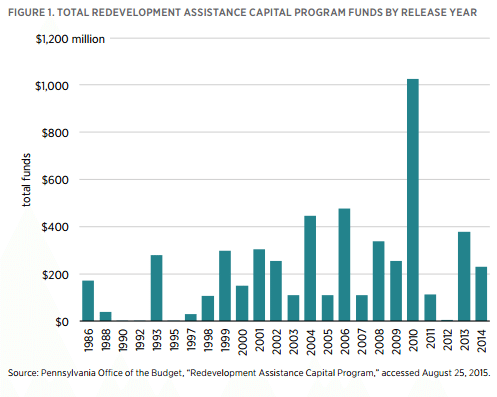
The lawmaker who sponsored that legislation, state Rep. Matt Gabler, is joining state Rep. Steven Mentzer in pushing a new bill that would cap RACP spending at $125 million in new projects a year. It would also limit spending for public improvement projects to $350 million annually.
Advertisements
A memo seeking support for the bill noted RACP and PIP were the two main drivers of debt over a 12-year period. The state’s debt obligation in the past fiscal year was about $10.6 billion, they said.
Jeffrey Sheridan, press secretary for Gov. Tom Wolf, said the administration is reviewing 2015 RACP applications. There are external and internal limits already in place to restrict the total amount of all capital debt allocations, he said.
“We will work with applicants, the General Assembly and local economic development officials to make the best use of these important resources,” he said. “We are committed to carefully managing debt and prudently allocating these funds.”
Advertisements
Of course, there’s always the free-market notion that perhaps the state could simply restructure its tax code, which includes a 9.9 percent corporate tax rate. With lower taxes for everyone, there might not be the need to worry about bonds, Millsap said.

