


By Rachel Martin | PA Independent
Pennsylvanians’ support for a tax on gas production depends on the detail of the questions asked, a comparison of two recent polls shows.
Advertisements
“Small businesses, labor unions and local governments across the commonwealth are deeply concerned about the economically damaging consequences associated with higher energy taxes,” Marcellus Shale Coalition President Dave Spigelmyer told Watchdog.org.
Two recent polls — one commissioned by MSC — show general support for a severance tax on natural gas production. However, the industry poll goes further, and asserts that support for the tax takes a nosedive if jobs are at stake.
But its research also shows that some of those surveyed don’t necessarily buy the argument that jobs will flee if a severance tax is imposed.
Advertisements
And for some, like Wendy Lee, a philosophy professor at Bloomsburg University of Pennsylvania, the larger jobs argument “begins to wear around its edges very quickly.”
As Watchdog reported, the severance-tax issue was a biggie in the race for governor, whether replacing the current impact-fees system or adding a tax.
Advertisements
Impact fees, while certainly providing benefits to the communities that receive them, produce a perverse incentive to have fewer wells, since the fee is assessed per well.
Robin Tilley, a spokesperson for the state Public Utility Commission, which administers the collection and distribution of impact fees, confirmed the premise.
“It makes sense that producers would reduce their number of active wells but increase production” with the remaining ones, she said.
Advertisements
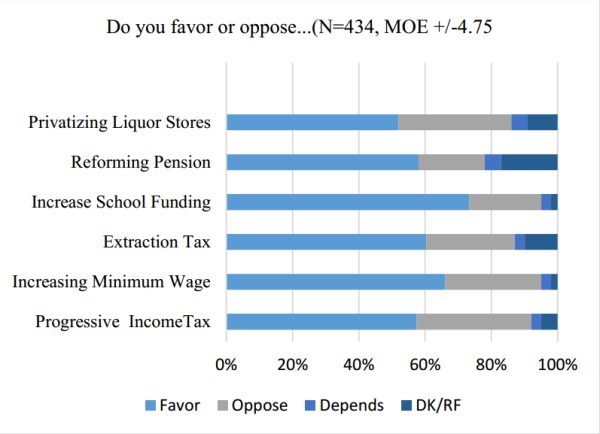
A Jan. 19 poll conducted by the Mercyhurst Center for Applied Politics was conducted right before Gov. Tom Wolf was sworn in. It asks a single question about the tax, among other items likely to dominate Wolf’s agenda.
A majority of 61 percent of those surveyed said they favor an extraction tax; 27 percent oppose.
Advertisements
Interestingly, the poll commissioned by the MSC also finds more people support such a tax than oppose it, 49 to 35 percent. That support falls along predictable party lines.
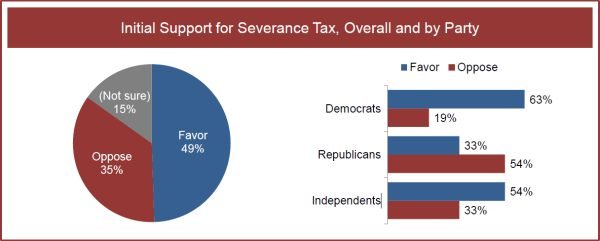
That poll was conducted by Anderson Robbins Research Feb. 19-22. It focused on this single issue and was released Feb. 27.
Advertisements
People also said taxes and fees on the industry were too low, by a margin of nine points.
Where the polls veer apart, however, is on the interplay between taxes and possible job losses. When people are asked if they support “raising taxes on Pennsylvania natural gas producers even if it results in jobs leaving the state and Pennsylvania residents losing their jobs,” support drops from 49 to 29 percent.
Advertisements
But job losses are not equally taken as a given.
Democrats seem less inclined to believe the jobs-will-flee argument: 58 percent of Democrats polled still said they believe it’s the “right time to raise taxes.”
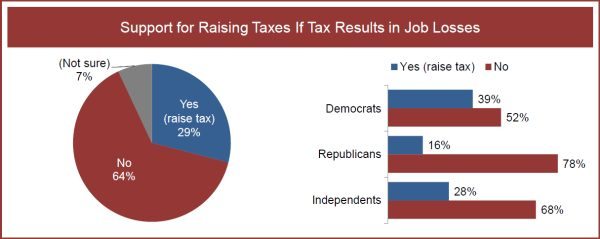
On the other hand, only 37 percent of independents and 26 percent of Republicans said it’s the right time.
Advertisements
This seems to be the work facing the natural-gas industry. If it can clearly show substantial job losses are bound to occur — or that the pain from job losses outweighs revenue gains — public support of the tax may fade as well.
Lee, an independent and longtime activist against fracking, is opposed to a severance tax, though not for the reason one might expect.
Advertisements
“I think a severance tax would be disastrous for the state,” she told Watchdog. “It entrenches the gas industry even more firmly in the tax base, making Pennsylvania citizens dependent on the revenue to fund key institutions like education.”
She also said she is skeptical of jobs claims by the industry, pointing for example to a late-January article in The New Republic, “Fracking Isn’t the Job Creator You Think it Is.”
But each side has its numbers. MSC spokesman Travis Windle notes an August 2014 study of construction employment related to the natural-gas industry, which concludes “natural gas exploration has been a strong engine of job growth.”
Advertisements
The ARR poll surveyed 804 Pennsylvania registered voters by phone, both landline and cell. Participants were randomly selected and “representative of Pennsylvania voters statewide.” The stated margin of error is plus or minus 3.5 percent.
Mercyhurst’s poll surveyed 434 Pennsylvania registered voters by phone. Participants were randomly selected from data obtained from Votermapping.com. The stated margin of error is plus or minus 4.75 points.

