By Marley Parish | Pennsylvania Capital-Star
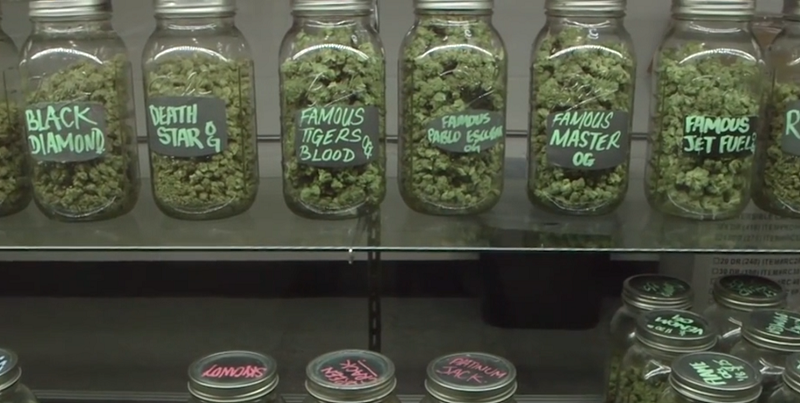
Ask Philadelphia City Council member Curtis Jones if he supports the legalization of adult-use cannabis, and he’ll say the jury is still out.
Advertisements
If it’s a choice between illegal cannabis and a regulated adult-use program, Jones, a Democrat representing the city’s 4th District, supports what he calls the “lesser of two evils.”
“But both are evils to me — just what we need — more intoxicants in the inner city. I’d rather you send me more books, send me fruits and vegetables to feed our kids. But if I had to choose, then there are a couple of caveats,” Jones told the Senate Law and Justice Committee on Monday, stressing that any cannabis program needs regulations, public input, and accountability.
The meeting was the first legislative hearing on adult-use cannabis, an issue receiving some bipartisan support for legalization over the last year after a repeated deadlock, which hasn’t disappeared among General Assembly leadership.
Advertisements
Pennsylvania’s neighbors — New York and New Jersey — have legalized recreational cannabis. Gov. Tom Wolf, a Democrat, changed his stance on adult-use cannabis in 2019, joining Lt. Gov. John Fetterman in calling for legalization.
There also is growing support for similar legislation among Pennsylvania residents. An October 2021 poll from Franklin & Marshall College showed 60 percent support among registered voters for cannabis legalization.
Advertisements
Last October, State Rep. Amen Brown, D-Philadelphia, and Senate Law and Justice Committee Chairperson Mike Regan, R-York, announced plans to introduce legislation legalizing adult-use cannabis to help fund law enforcement.
Last year, Sens. Dan Laughlin, R-Erie, and Sharif Street, D-Philadelphia, introduced a bill to legalize recreational cannabis use, estimating that it could generate $400 million to $1 billion in new tax revenue.
And while not every testifier on Monday immediately was on board with endorsing adult-use cannabis, the majority said a regulated program could help curb demand on the black market, where potentially dangerous — and deadly — cannabis is already circulating in Pennsylvania communities.
Advertisements
“There will always be a black market, but if we legalize cannabis, it would not be as large as it is,” Brown said.
Philadelphia decriminalized cannabis in 2014, but it’s still not legalized, meaning that a person could face fines — not criminal charges — if they’re caught carrying less than 30 grams of the drug.
Advertisements
Brown and Jones also recounted stories from their districts where constituents assumed cannabis was legal and outlined how people placed orders using a mobile app. Those products, however, are likely untested and unregulated, containing toxic pathogens that a state-supervised program could test for before entering the market.
“Why can’t we help that same person do it the right way?” Brown says of people currently selling illicit cannabis. “That same person who has this ‘business’ for whatever reason, typically in communities like mine … someone might be getting in this business of selling marijuana because they need to take care of their family, and sometimes that results in them getting incarcerated for wanting to take care of home. I don’t think people should be put behind bars for wanting to take care of home.”
Advertisements
Lawmakers also heard from cannabis industry employees, who outlined specific security measures used at cannabis facilities to ensure products are safe, including surveillance, sale tracking, and limiting what’s left on the floor at dispensaries.
“You really don’t know what you’re getting, so would regulation take care of that? Probably,” Dauphin County Chief Detective John Goshert said of illicit cannabis that’s currently being sold, and how a state-regulated program could combat toxic products.
Advertisements
District attorneys from Warren and York counties testified before the panel, telling lawmakers that regulation is necessary if Pennsylvania legalizes adult-use cannabis to keep the drug away from children and ensure people under the influence don’t get behind the wheel. They also requested clear guidance for law enforcement to use.
“We don’t need to be arresting people for driving when they’re fine to drive just because they use marijuana, which in all intents and purposes, it’s legal now,” Warren County District Attorney Robert Greene said, telling lawmakers to either “get on board and legalize” cannabis or wait and “eventually do it anyway.”
York County District Attorney David Sunday, who did not explicitly voice support for legalization, cautioned lawmakers to decide based on fact and rooted in science.
Advertisements
During his testimony, Sunday said that most violent crime in York County relates to selling or purchasing cannabis. But he added that there are “hundreds of underlying causes” that have triggered the increase in community violence.
“When we talk about legalizing marijuana and crime, we also have to remember that public safety is directly tied to public health. Those two are inextricably combined,” Sunday said. “You cannot have a public that is unhealthy — physically, mentally, economically — and then expect us to have low amounts of crime.”
Advertisements
He added: “The only way to accurately do that is to look at places where it’s already happened.”
The Senate Law and Justice Committee will hold another hearing on adult-use cannabis within the next month, Regan said.
Pennsylvania Capital-Star is part of States Newsroom, a network of news bureaus supported by grants and a coalition of donors as a 501c(3) public charity. Pennsylvania Capital-Star maintains editorial independence. Contact Editor John Micek for questions: info@penncapital-star.com. Follow Pennsylvania Capital-Star on Facebook and Twitter.
Advertisements
Report a correction via email | Editorial standards and policies