


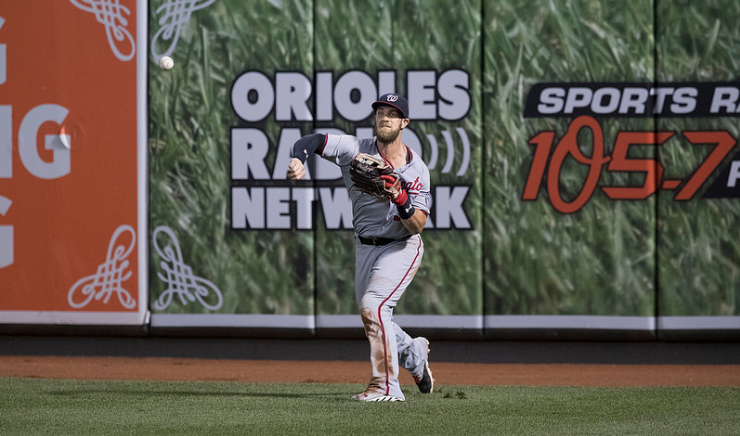
Baseball superstar Bryce Harper is about to enjoy a huge pay raise after signing as a free agent with the Philadelphia Phillies.
Advertisements
But on top of the 13-year, $330 million contract that the slugger signed this week, Harper will be enjoying another notable financial benefit as a result of moving to Pennsylvania – a significant decrease in his income tax rate.
For the first seven years of his career, Harper, 26, played for the Washington Nationals, racking up an MVP award, a Rookie of the Year award and six All-Star selections among other accolades. By just about any measure, he’s one of the game’s brightest stars and was, along with infielder Manny Machado, one of the premier free agents available this offseason.
By moving away from Washington, D.C., which has a top income tax rate of 8.95 percent, Harper stands to save almost $10 million over the next 13 years thanks to Pennsylvania’s lower income tax rate of 3.07 percent.
Advertisements
As a result of a plethora of changes to state laws around the nation since the 1990s, athletes pay income tax to each state where they play in games. As a result, the change in his home park, Citizens Bank Park, helps Harper’s income tax situation for 81 games out of the 162-game schedule.
Media reports indicate that Harper was also wooed by the San Francisco Giants and Los Angeles Dodgers, and in either of those cities he would’ve faced California’s 13.3 percent income tax for the highest earners.
Advertisements
For home games over the next 13 years, Harper can expect to pay a total of about $5 million in income taxes. If he had signed the same contract with Washington, he would be looking at $14.7 million in income taxes. If he had signed in San Francisco or Los Angeles, that number would balloon to about $22 million.
Machado, the other megastar available to any team to sign this offseason, went to the San Diego Padres for a reported 10-year, $300 million deal. Machado played part of last season for Los Angeles after being traded by the only team he’d ever previously played for, the Baltimore Orioles.
Also 26, Machado was taxed at a rate of 5.75 percent during his time in Maryland, but the trade to the Dodgers and subsequent signing with the Padres made him subject to California’s 13.3 percent top tax bracket. Among the teams reportedly bidding to sign Machado were the Chicago White Sox, and the top tax bracket in Illinois is 4.95 percent, though Democratic lawmakers and Gov. J.B. Pritzker are working to change the state’s flat income tax system to a progressive one in which higher wage earners pay higher rates.
Advertisements
Baseball insiders say the White Sox weren’t willing to match San Diego’s offer for Machado, but if they had, Machado conceivably could’ve been looking at an Illinois tax bill of $7.4 million over the life of the contract if the current 4.95 percent rate remained. Instead, he’s looking at more like $19.9 million with the Padres – with one important caveat.
A portion of Machado’s salary will be paid in the form of “signing bonuses” rather than gameday checks. Such bonuses are taxed where the player lives, rather than where he works. And since Machado makes his home in Florida, where there is no state income tax, he’ll keep a significantly larger portion of those $2 million annual checks – not to mention the $20 million he received immediately after signing his deal with the Padres.
Advertisements
Harper has worked out a similar deal and will get a $1.5 million signing bonus each year, plus a $20 million bonus this year. He reportedly lives in Las Vegas and will not have to pay state income tax on that amount since Nevada does not collect one.


