


By Rick Schmitt and Paul Feldman | FairWarning
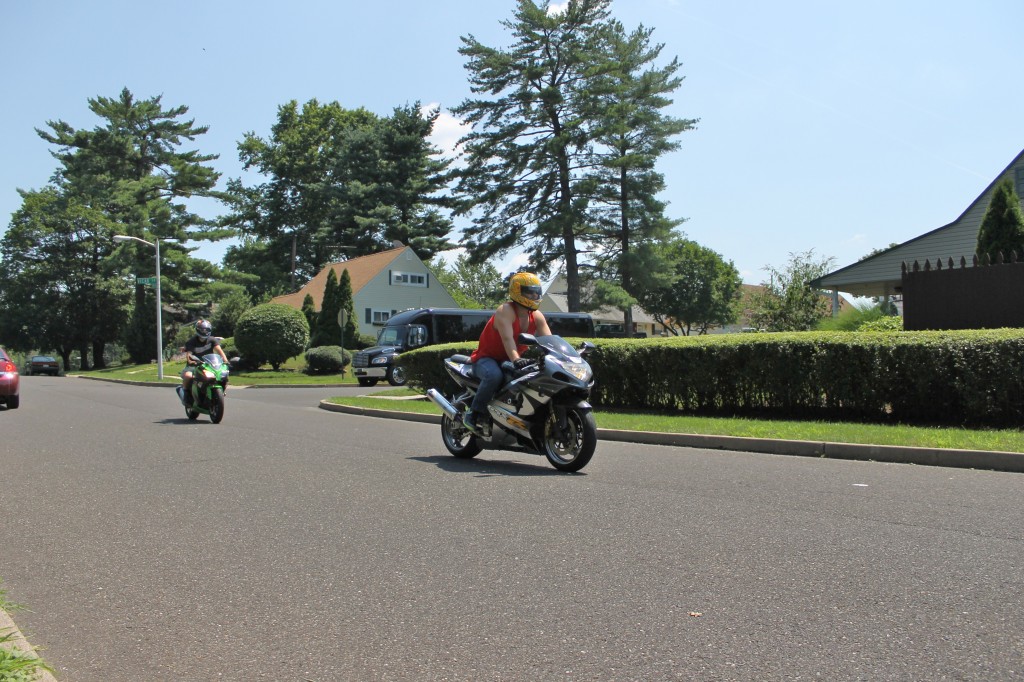
Credit: Tom Sofield/LevittownNow.com
After a long downward trend, U.S. traffic deaths are on the rise again, and a key factor is the stubbornly high fatality toll among some of the most exposed people on the road: motorcyclists.
Advertisements
Nevertheless, federal regulators have balked at requiring a safety measure that, many experts say, could save hundreds of bikers’ lives every year.
Anti-lock brake systems, a standard feature on lots of passenger vehicles since the 1990s, have been touted for years as a potentially powerful tool to cut motorcycle deaths. The technology, known as ABS, works by preventing the wheels from locking up during hard braking and improving control amid emergencies or slippery road conditions.
In the U.S., major law enforcement agencies, including the California Highway Patrol and the New York City Police Department, require that all motorcycles in their fleets have ABS. Around the world, ABS-equipped motorcycles are fast becoming standard. All new large bikes sold in Europe must now have ABS. On a phased-in schedule, Japan, India and Brazil are following suit.
Advertisements
“It is hard to come up with something else that has the potential to be as important for motorcycle safety,” said Adrian Lund, president of the Insurance Institute for Highway Safety, which estimates that nearly one-third of all fatal crashes from motorcycling every year, and many injuries, could be prevented by a federal ABS mandate.
Federal regulators at the National Highway Traffic Safety Administration, the officials who would be in a position to do something, have been criticized for taking an ambiguous, even mysterious stance. NHTSA has been something of an ABS cheerleader — praising it as a life-saver in the case of BMW Group, a leader in offering the technology — even though the safety agency fails to require it as a standard safety feature.
Advertisements
In 2009, the agency appeared close to mandating ABS on motorcycles. But within a couple of years, it shifted gears and shelved the proposal. The bottom line was that officials decided that there was insufficient proof that the benefits, measured by lives saved and injuries avoided, would outweigh costs to manufacturers.
And given that NHTSA lacked the political clout and scientific muscle to require ABS during the Obama administration, there appears to be practically no chance it will happen under the regulation-averse Trump administration, even with the annual death toll among motorcyclists hovering at close to 5,000. In a statement to FairWarning, the agency said its latest study on the issue, conducted in 2010, “did not demonstrate clear evidence to support regulatory activity and the agency currently does not have plans to pursue a new federal mandate to require ABS.”
NHTSA typically is slow to take action, when it acts at all. As FairWarning has reported, since at least 2011 NHTSA has been considering a crackdown on the sale of novelty motorcycle helmets that are nearly worthless in a crash. In May 2015, it finally took a preliminary step, issuing a notice of proposed rulemaking, but after nearly two years, the agency still has not issued a rule.
Advertisements
In the absence of action on ABS, motorcycle manufacturers gradually have been making the technology available. BMW Group introduced the first motorcycle with ABS in 1988, and made them standard equipment on all of the bikes it sells in the U.S. in 2012. According to the Insurance Institute, BMW remains the only major manufacturer to do so in the U.S.
Harley-Davidson, the nation’s largest manufacturer with about half of all domestic sales, began offering ABS on police department motorcycles in 2005, and then as optional equipment on some civilian bikes starting in 2008. By 2014, according to a court filing, Harley offered ABS as optional or standard on all of its models. The company declined comment for this story.
Advertisements
Yet even though sales of ABS-equipped motorcycles are increasing, they still accounted for no more than about 15 percent of the more than 7 million motorcycles registered in the U.S. in 2015, according to figures from Exponent Inc. The Menlo Park, Calif., consulting firm provided the data for Harley in connection with a lawsuit the motorcycle company was defending.
Much of the opposition to ABS has come from rider groups. The American Motorcyclist Association, for example, calls ABS “a powerful safety feature” but says riders should be free to choose whether their bikes have it. The group also opposes laws requiring motorcyclists to wear helmets, even though they have been proven to save lives and reduce health care costs.
Advertisements
Harley’s business approach has enabled it to sell ABS as an expensive safety option, while not offending the libertarian sensibilities of rider groups, including concerns that ABS components might clutter up the classic Harley look. At the same time, Harley has long acknowledged ABS safety benefits.
“So which Harley has ABS? Can’t tell? That’s intentional,” the company said in a video promoting its new line of ABS bikes in 2008. “They look nearly identical in going down the road,” said a voiceover. “But while they may look the same, there is definitely a difference during an emergency braking event.”
Advertisements
Nelson Roach, a Daingerfield, Texas, plaintiffs lawyer who brought an unsuccessful lawsuit against Harley related to its failure to use ABS throughout its product lines, likens the company’s approach to the way auto makers once resisted seat belt requirements. “In the 1970s, carmakers fought mandatory seat belts for two reasons. They wanted to continue selling them as a luxury option, and they were afraid a mandate would discourage people from buying cars,” he said.
For the last decade, Harley has “been doing the same thing with anti-lock brakes,” said Roach, who accuses NHTSA of kowtowing to the motorcycle industry.
Roach represented a Pittsburg, Texas, couple, who filed suit against Harley in federal court after a wreck in 2013 that they said would not have happened if their Harley had ABS. The husband had slammed on the brakes of his Harley to avoid a Chevy Avalanche pickup that had turned in his path. His wife was thrown from the bike and hit the pavement. Each suffered broken bones and brain injuries; their medical bills totaled more than $750,000.
Advertisements
Attorneys for Harley blamed the crash on the couple’s negligence, and noted that neither the husband nor the wife were wearing helmets. In January, the jury sided with Harley.
Even when Harley offers ABS, it has run into trouble. NHTSA announced last summer it was opening a preliminary investigation into reports of sudden ABS brake system failures on Harley models. Up to 430,000 ABS-equipped motorcycles for model years 2008-2011 are potentially affected. Harley has said it believes the problem lies with riders not servicing brake fluids regularly.
Advertisements
A bright spot for ABS advocates have been police departments around the country that have insisted for years on buying bikes equipped with the technology. For instance, both the California Highway Patrol and the Los Angeles Police Department have fleets of more than 400 ABS-equipped motorcycles.
“We see that as an important safety feature and want to provide our officers with the safest possible equipment,” said Steven Mills, head of the California Highway Patrol fleet operations section.
Likewise, all motorcycles purchased by the NYPD since 2006 – 130 Harley-Davidson Road Kings — have ABS.
Improper braking has long been identified as a major factor in motorcycle crashes.
Advertisements
Studies have shown that most riders instinctively slam on the brakes to avoid accidents. But if the brakes are applied too hard, the wheels can lock, sending the bike into a tailspin or down to the ground. Braking on a motorcycle can be particularly tricky for less experienced riders and in poor weather because bikes have separate brake controls for the front and rear wheels, and either one can lock up.
ABS works by anticipating lockup, and modulating pressure on the brakes until traction is restored. While some riders may be able to stop as well or better with conventional brakes, it is a different story when conditions deteriorate.
“It’s one of those things silent in the background until you need it and then it has your back if the rider makes a mistake, panics or the road surface changes,” said Stacey Axmaker, who runs becrashfree.com, a web-based membership organization for riders who pledge to wear protective gear and take other crash-prevention measures. ABS is “great technology for motorcycles,” he said.
Advertisements
Less than a decade ago, NHTSA seemed close to mandating ABS on motorcycles, which long have been the most dangerous mode of travel. Motorcycle sales – and deaths – surged as a spurt of new motorcyclists, many of them older than the usual beginners in the past, started hitting the road. That, in turn, sent regulators scrambling to end the carnage.
Citing “potentially large benefits for braking improvements,” the safety agency put ABS on its regulatory agenda in July 2009, with plans to launch a rule-making process the next year.
By then, a significant and growing body of pro-ABS research had emerged, some conducted by the agency itself. Road tests consistently showed ABS outperforming conventional brakes in rider control and bike stability.
The Insurance Institute was the first to look at actual crash data, and its conclusions were stunning. Eventually, in a 2013 study, motorcycles equipped with ABS were found to be 31 percent less likely to be involved in fatal crashes, signaling the potential to save more than 1,500 lives a year if all bikes had the feature. In all, motorcycle deaths totaled 4,976 in 2015, up 8.3 percent from the year before though below 2008’s record high of 5,312.
Advertisements
Other research by an affiliated organization, the Highway Loss Data Institute, found that collision losses for ABS-equipped bikes were 21 percent lower than those for motorcycles with conventional brakes. ABS was seen as rivaling helmets as the best tool for reducing deaths and injuries.
Additional pro-ABS evidence piled up overseas. Researchers in Sweden concluded that 42 percent of all severe and fatal motorcycle accidents in that country could be avoided with motorcycle ABS. The Federal Research Institute of Germany determined in 2009 that benefits of ABS were “undeniable.”
The motorcycle industry pushed back, funding research that raised questions about ABS. But with the bulk of evidence behind ABS, the European Union voted to require it on medium and high-performance motorcycles starting in January 2016.
In the U.S., however, the push for ABS stalled. Engineers at NHTSA questioned whether it was the brakes or other factors leading to lower crash rates. Maybe, for instance, riders who chose ABS bikes tended to be more experienced or careful. The skepticism was fueled partly by the mixed safety record with early versions of ABS on cars.
The safety agency decided to launch its own study. Its methodology and conclusions remain controversial to this day.
The study used accident data involving motorcycles with, and without, ABS. But it made questionable judgments about the kinds of accidents that ABS brakes would likely prevent. For example, according to an analysis by the Insurance Institute, the study excluded some crashes where a vehicle turned left in front of the motorcyclist, on the debatable theory that there was nothing the biker could have done to prevent the collision.
The conclusion, in a report published in June 2010, was a muddle. In one scenario, NHTSA found that ABS bikes were actually slightly more crash-prone; in another, it said the data were too thin to provide answers. “Using this methodology, we did not find statistically-significant results to suggest that ABS affects motorcycle crash risk,” the authors concluded.
Advertisements
Critics considered the study an outlier, and said waiting for more data before acting would mean needlessly allowing more people to be killed.
“It is both defective and, by ignoring the other research available to NHTSA, disingenuous,” said Fergus Nolan, a Memphis, Tenn., rider and activist. Nolan runs a website called the Motorcycle Action Network, which is “dedicated to making American streets safer for motorcyclists and the drivers around them.”
Nonetheless, in March 2011, the agency dropped motorcycle ABS from its regulatory agenda. A report on the agency website declared: “Decision to evaluate with more data later.”
The Insurance Institute petitioned NHTSA in 2013 to revive an ABS rulemaking but it was rebuffed. “We don’t see any action on their part to move this forward,” Lund said. “We are not entirely clear why.”
David Strickland, NHTSA’s administrator from 2010 to 2014, said in an interview with FairWarning that he remains enthusiastic about the possibility of ABS-equipped motorcycles saving lives. But he said the agency faced a Catch 22: Too few motorcycles with ABS were being sold to give the agency enough crash data to conduct a thorough analysis that could justify making a new rule.
Other former NHTSA officials and engineers also defend the agency’s stance.
“When issuing a rule, the research and analysis has to be airtight,” said Marilena Amoni, a former associate administrator of the agency who signed off on the June 2010 ABS report.
Amoni has served on the board of a nonprofit group that supports a worldwide motorcycle ABS mandate as part of a road safety campaign backed by the United Nations and World Health Organization. “My personal views aside, the analysis wasn’t strong [enough] to support a rule,” Amoni said. “More research was needed.”
George Soodoo, a NHTSA engineer who oversaw much of the agency’s work on motorcycle ABS before retiring in 2015, dismissed the significance of foreign regulators moving ahead with ABS mandates. “They don’t have to show the same level of rigor we have,” he said.
Yet the agency’s ambivalence was apparent when BMW became the first manufacturer to offer ABS as standard equipment on its entire line of motorcycles. “It’s time for all of us in the motorcycle industry to embrace the benefits of ABS,” Pieter de Waal, a vice president in BMW’s U.S. unit, said in an April 2011 news release announcing the company’s ABS plans.
“Extensive testing by safety experts, law enforcement authorities and journalists around the world consistently demonstrates that ABS reduces overall crashes and saves lives.”
NHTSA cheered the company’s initiative. “We commend BMW for taking the lead to improve motorcycle safety,” Strickland, then the agency’s administrator, stated in the same news release. “Motorcycle fatalities and injuries have been on an upward trend for the past ten years and ABS and other safety technologies can help reduce these tragedies.”

