
By Julia Rentsch
By 11 p.m. on Christmas Eve, the line of people outside the post office was already 100 strong.
Clutching thermoses of hot chocolate or coffee, stamp collectors and history enthusiasts exchanged stories and holiday greetings in the lead-up to 12:01 a.m., when the office would open and begin postmarking envelopes with the location and the date: Washington Crossing, Pennsylvania, December 25, 1976.
The enthusiasm that led those hundred people to queue in the cold had been fueled throughout the preceding year by a widespread national celebration, with events taking place across the U.S. throughout 1975 and 1976. Festivals drew thousands of attendees, the American Freedom Train steamed across the country, and the National Air and Space Museum had its grand opening on the National Mall. Billboards placed around the country sponsored by the New Jersey State Bicentennial Commission implored the public to follow in Washington’s footsteps to the site of the crossing: “GO WHERE HE WENT,” they read.

Just a few hours after the philatelist queue dispersed, thousands of spectators would arrive in Washington Crossing to witness the 200th anniversary reenactment of General George Washington’s crossing of the Delaware River, which allowed Continental Army troops to conduct a surprise attack on the Hessian garrison at Trenton and began a period known as the Ten Crucial Days, often cited as the turning point of the American Revolution.
This December, reenactors and audience members will once again come to Washington Crossing for the 74th annual Crossing Reenactments and the 250th anniversary of the daring ploy that made independence possible.
Many of those participating remember the Bicentennial and are experiencing the second major anniversary commemoration of their lifetimes. Others will attend their very first reenactment, and some may later mark this as the starting point for a life-long hobby.
The Bicentennial as a beginning
At the time of the Bicentennial, Revolutionary War reenacting was a relatively new and exciting pastime. At its peak in 1976, national reenacting organizations reported upwards of 20,000 active participants. Entire families would often participate in reenactments in an era when weekends were not so heavily booked with soccer practices and karate classes.
“All of our co-reenactors were all young families,” said Annette Earling, executive director of the Washington Crossing Park Association, the nonprofit supporting Washington Crossing State Park, New Jersey. “They were all people with kids, or newlyweds, and it was a social event. The kids all played, they gave us colonial games, and I had my first kiss when I was 14 at a reenactment.”
Earling’s father, David Earling, was a reenactor and chairman of the NJ Bicentennial Commission.
“We would go all up and down the East Coast doing reenactments, all through the Bicentennial and the years before and after,” Earling said. “It was our family’s way of going camping. Like, I never went camping with a sleeping bag or a regular tent. We always went with wool blankets and muslin tents.”

The family lived in Titusville, NJ, at the time, and attended every Crossing Reenactment, Earling said. Twelve years old for the Bicentennial Crossing, Earling portrayed a camp follower along with her mother and sister, while her brother served as an army drummer. Her mother hand-sewed the family’s outfits from Butterick patterns purchased at Sears.
“We cooked, and we sewed, and we did drop spindle making yarn, and we demonstrated crafts,” Earling said. “Today, if I smell apples and bacon cooking, I am immediately back in that, because we cooked apples and bacon constantly because it’s something you can feed people and they always wanted to try it, because it smelled delicious.”
The role of a camp follower was not easily assumed by every woman. For Stacy Roth, director of the Friends of Washington Crossing Park Fifes & Drums, it was the military aspect of reenacting that held more allure than the civilian side.
“I grew up in areas where Washington and his army had marched right up the road, and so, to me, it was kind of magical – it was like knights in armor,” Roth said of her childhood in New Jersey. “That these armies had traveled the very same roads that I go on every day, it had a lot of relevance. There was a local connection.”
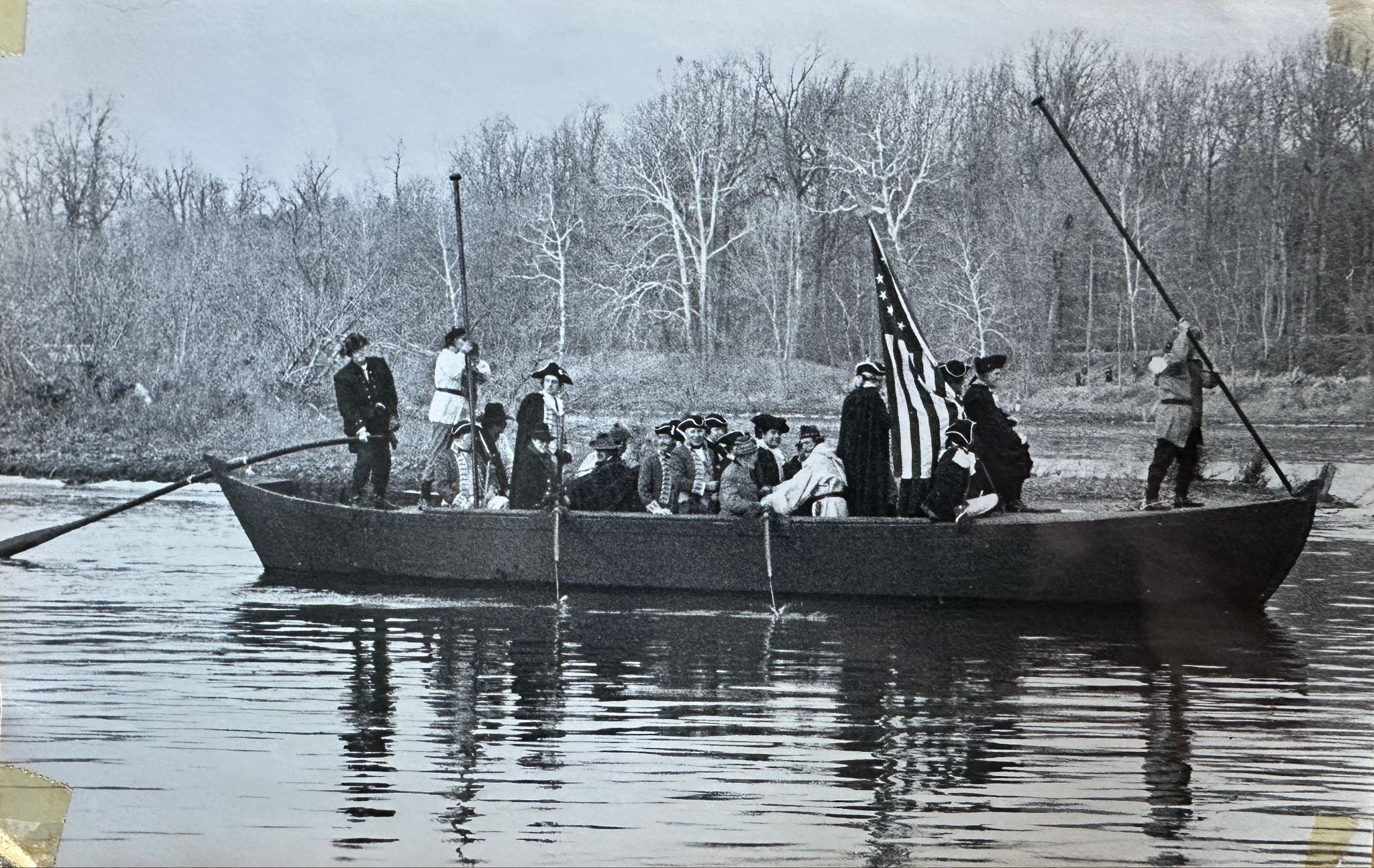
Conventions of the time, however, did not allow women to join in military aspects of reenacting. The Bicentennial crossing event is said to be the first time that a woman, Ann Hawkes Hutton (1909 – 2003, credited with a large role in the preservation of Washington Crossing Historic Park’s Thompson Neely House as well as the Memorial Building, now the Visitor Center) was permitted to openly participate, but Roth also remembers women who had tried to pass as military men being discovered and thrown out of reenacting events.
Through sheer luck, the Bicentennial crossing allowed 18-year-old Stacy one of her first chances to join the male re-enactors. While standing in a crowd along the Delaware listening to David Earling read out the names of those who would be going in the boats with Washington, Roth heard him repeat a name and decided to inquire.
“I went up and I said, hey, you just called the same person’s name twice. Does that mean there’s another space on the boat? And he said, I guess it does,” Roth recalled.
To ensure that the youth he saw before him was over the age of 16 – the requirement to ride in a boat – Earling then asked to see Roth’s driver’s license. Luckily for Roth, she has a gender-neutral name and the driver’s licenses of the day did not feature photos; the tiny, betraying “F” in the bottom corner was easily covered with a well-placed thumb.
“All right, son,” Roth recalls Earling saying.
She recalls that while she had started the day without any intention of trying to get on a crossing boat, she was happy to have success.
“It was really exciting. Of course, you know, I’m tiny, so I was packed like a sardine on the boat,” she said. “And most of what I remember was a lot of helicopters flying overhead, making a lot of noise and filming the thing.”
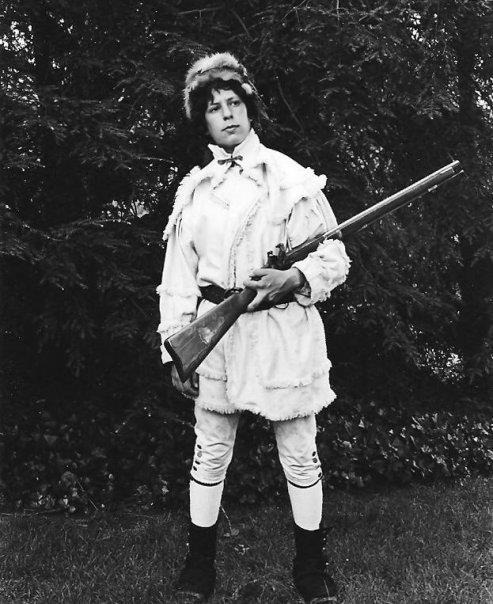
Roth had only begun reenacting a few months prior, after seeing an artillery demonstration at a public library. Leading up to the crossing, she and her unit marched the entire route of Washington’s retreat through the Jerseys, from Fort Lee to Trenton, having skirmishes along the way.
An accomplished guitarist, Roth found her way into the hobby through drumming and fifing with a supportive unit whose members would keep her secret.
“It wasn’t a woman’s job, back then. But by the time I was 18, I knew about 150 different songs from the American Revolution on the guitar. So I was more interested in that (compared with being a camp follower).”
Today, most reenacting units are open to allowing women participate in the military aspect. This change occurred in the early- to mid-90s, Roth said, and inspired her to get back into the hobby in 1995 after leaving to go to school in the mid-80s.
After returning to reenacting, Roth went on to write a book about the portrayal of historical characters through interactive dramatization or roleplaying, which is also known as first-person historical interpretation.
Happy that she no longer has to hide to participate in the hobby she loves, Roth said she thinks what matters more than a reenactor’s gender is their mindset and their willingness to engage with the historical context of who they are portraying.
“Just trying to experience a little bit of what they might have gone through, knowing that you can’t completely recreate it because you’re not suffering the way those people did… it has a real mystical feeling to it, like echoes,” she said. “I think if you’re participating in a reenactment, it’s good to try to put yourself in the place of the people who fought in it, and do things somewhat accurately.”
Reenacting in the modern era
Being a hobbyist reenactor in 2026 looks pretty different from the landscape in 1976, when reenactors might have gone out to an event every week or two weeks. Now, events are less frequent; organizing a reenactment requires myriad logistical considerations from insurance to permitting. Getting permission to fire black-powder weapons – even replica antique cannon and firearms – can be difficult in some locations, while during the Bicentennial, attitudes were mainly curious and permissive.
This is not so much an issue at dedicated sites like Washington Crossing Historic Park, where tens of thousands are expected to gather for two crossing events in December: the First Crossing on Sunday, December 13th, and the Christmas Crossing on Friday the 25th.
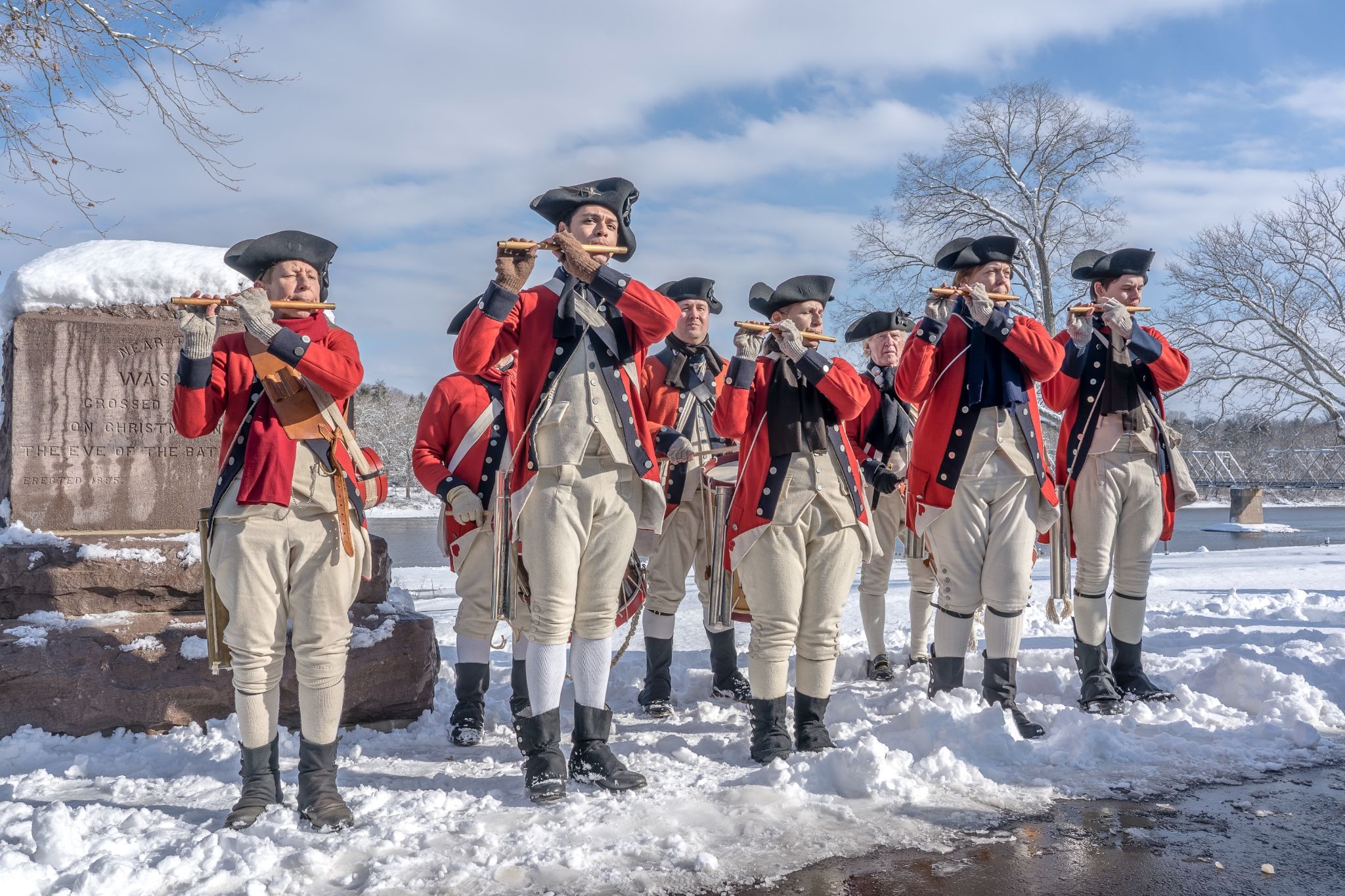
Members of the 3rd New Jersey “Greys” Regiment can be seen at the Washington Crossing Reenactment portraying the 16th Continental Regiment of Massachusetts, who wear distinctive green coats with black facings.
There are currently over 100 members of Greys, and the average age is 27, said unit commander and president James McKane. This makes the Greys one of the largest and youngest units in a hobby that can boast less than 5,000 total participants nationwide.
Rather than depicting a more recent time period – when the clothes were more comfortable and staying overnight didn’t necessarily mean sleeping on the floor or the ground – Revolutionary War reenacting can be one of the more intense ways to participate in the hobby. If a Revolutionary War unit is inclined toward historical accuracy, it can mean spending long hours in the bitter cold or sweltering heat, marching through inhospitable terrain, and occasionally consuming tasteless period cuisine (see: ships biscuits).

With a whole world of potential hobbies available for those with extra time on their hands, it’s understandable why some people wouldn’t choose to sign up as a reenactor, McKane said. But for those who get a thrill when they hear a volley of musket fire or love the camaraderie with their unit mates – sometimes fueled by mutual suffering – it becomes a rewarding way to spend their free time.
“We’re being uncomfortable for maybe, at most, 48 hours, sometimes a little less than that – but think about the guys that we’re portraying that had to go through this constantly,” McKane said.
“It’s going to make you appreciate a lot of other things a lot more.”
This level of dedication to accuracy was what drew interest to the 3rd New Jersey from noted documentary filmmaker Ken Burns. When Burns’ crewmembers showed up at the reenactment of the Battle of Monmouth one year and asked which unit they should film, McKane later learned that the site manager had pointed out the Greys’ austere setup among a sea of anachronistic white canvas tents.
“They said, ‘See those idiots lying on the ground? Go talk to them!’” McKane said.
Accurate reenacting isn’t all white-knuckle, however – some historically accurate clothing materials, like wool, are actually far more temperature-regulating and breathable than modern alternatives like polyester. It can also be cheaper to DIY than to buy off the rack. The Greys help their members learn to sew, source authentic patterns, and buy fabric in bulk to bring down the cost: by his own notes, a yard of linen has increased nearly tenfold in price, from $3.95 to $26.95, since McKane joined the Greys in 2018, he said.
“It is actually cheaper to reenact as authentically as you can, at least by clothing standards, than it is just to buy off the rack,” he said. ”A regimental (uniform) you can buy off the rack for $650 to $700, but if you make it, you can make it for less than $150 and it’s made by you, by hand, the way the originals were made.”
While having the right clothes does not automatically make a person a better reenactor, McKane likes to pay attention to what historians call “material culture,” he said. Not every Revolutionary War-era reenacting unit agrees on the finer points of material culture, but for McKane, the way that a reenactor looks and acts – the way they are dressed, how they conduct their military drills – is important for setting the right first impression.
“The story that we’re telling as reenactors is as much visual as it is verbal,” he said. “When somebody walks into camp and they look at you, what story are you already telling? The first checkmark is looking at somebody visually and trying to represent the 18th century as best we can.”

The legacy of the Bicentennial directly played into making it feasible for units to reenact in this authentic way. Enthusiasm for the telling of Revolutionary War stories at the time resulted in an influx in research that led to greater understanding of material culture, and the arrival of the Internet meant sharing this knowledge became much easier, McKane said.
The internet not only made it easier to get good information; it made it much easier to connect with fellow reenactors. Rather than the phone chains and printed calendars that helped Bicentennial era reenactors coordinate, today’s reenactors connect via Facebook groups, Discord servers and group chats, McKane said.
“There are so many options now to connect with people compared to the ‘70s, and I think that leads directly into the rise of more authentic material culture, different camping styles, or even these marches that go along the proper routes rather than parade routes,” McKane said.
The ease of communication also helps those who are new to the hobby with picking out a unit to join, which is all about shopping around until you find your right fit, McKane said.
“I thought I’d never do a British impression,” said Alex Robb, who is a member of the Grays, the 15th Regiment Light Infantry Company, and serves as the Interpretive Programs Specialist at Friends of Washington Crossing Park. “But after a couple of years of being in the hobby, my thinking matured, and I realized that their convictions and sacrifices were just as sacred as those of the Americans. And, if the whole point of this is educating not only ourselves but the public, then one has to put aside their own prejudices and learn both sides of the story.”
For those who are still deciding, events like the Crossing Reenactments that do not require reenactors to sign up as a member of a unit offer a point of entry. McKane himself participated in the Crossing Reenactments for three years, starting at age 16 as a history-loving high schooler, before joining the Greys.
Among reenactors, there is hope that the large crowds and media attention at events surrounding the 250th will translate into a recruitment boom. With 250th anniversaries related to the eight-year war occurring through 2033, the 255th anniversary of early events like Washington’s Crossing of the Delaware will be celebrated right on the tail of the 250th commemoration of the Battle of Yorktown in 2031. In other words, there are still many more anniversaries to mark in the near future.
The Crossing Legacy
Echoes of both the distant and recent past run through regularly recurring events like clockwork.
Ahead of the Bicentennial reenactment, Ron Rinaldi received an invitation to attend the event from the then-portrayer of George Washington, St. John Terrell, after Rinaldi’s mother, the journalist and author Ann Rinaldi, mentioned during an interview with the entertainer that she had a 14-year-old son at home.
Prior to attending, Rinaldi said he didn’t have an outsize interest in history. But his memories of the Bicentennial consist of sitting on shore by a campfire and marveling at those who were portraying Washington’s army.
“I was fascinated by the soldiers, the reenactors … with the confidence of soldiers. I was really intrigued. I was wondering how I could become one of those guys,” he said.
The following Christmas Day, in 1977, Rinaldi attended the reenactment again, this time a little more prepared, but still planning to stay on shore. It was St. John Terrell’s last year portraying Washington before he planned to retire, but kids needed to be 16 before they could ride in a boat, for insurance purposes, Rinaldi said, meaning he was going to miss his chance to ride along the storied portrayer of Washington.

“As he marched down with his officers and soldiers, they walked past the trees and the soldiers sitting by the campfires, and he looked at me, and he stopped,” Rinaldi said. “He says, ‘Come with me.’ … And he took me by the hand and I marched with him. It was unbelievable.”
Terrell led Rinaldi to one of the boats, brushing off his underaged status. “What are they going to do, fire me?” Rinaldi recalls Terrell saying just before they rode across the river together.
“That was 1977, and he’s in the bow of the boat and I’m down on the left-hand side. It was 30 years later, in 2007, when I was (portraying) Washington … and my son is sitting in the boat right next to me, right where I was 30 years ago to the day.”

His son, James, was only 10 at the time and was participating in reenactments as a drummer.
“That really was something I will never forget,” Rinaldi said.
Though he was mystified as a fifteen-year-old when Terrell singled him out, Rinaldi said he has come to understand the older reenactor’s drive to name a successor.
“So he did that, and I over the years came to see why, because I’m getting older now. I can see how we’re trying to get the younger generation involved… let them touch stuff, line them up and drill them, so that they can actually partake. I think that’s how you get somebody young interested in history.”
This 250th year, the lessons and legacy of the Bicentennial are anticipated to be particularly poignant. For all the ways that the 2026 reenacting experience is different from what they put together in 1976, the commemoration is much the same: at times jubilant, and at others somberly reflective.
Daniel P. Finegan, who stood in line with his father, Pat, and brother, Ed, waiting for the post office to open in the early hours of Dec. 25, 1976, still displays the two specially postmarked prints in his home and his office as a reminder not only of the crossing, but of his fond memories.

“I treasure the park and celebrate its history, including as it so appropriately and well honors the courage of General Washington and his soldiers in their fight for liberty and freedom,” Finegan wrote. “I also treasure these prints, that morning, and the memory of my father. On that historic anniversary date and many other times, he inspired my brother and me, and our family and friends, to know and understand our history and always appreciate, and pass on to others, our many, many blessings.”
–
Today, the Friends of Washington Crossing Park continue to carry on the reenactment tradition. What began as a grassroots effort in 2009 when budget cuts threatened the Crossing Reenactment has transformed Washington Crossing Historic Park into a year-round destination for historical education. In preparation for the historic milestone of the 250th, FWCP has invested $2.5 million to help keep the site and the Crossing Reenactments alive for generations to come.
You can experience the 250th Crossing Reenactments at Washington Crossing Historic Park this December. Due to significantly higher attendance anticipated for the 250th anniversary in 2026, advance registration will be required for both the First Crossing and Christmas Crossing reenactments.
Visit the Friends of Washington Crossing Park website, www.washingtoncrossingpark.org/cross-with-us, to learn more and register.