



Credit: pmk00001
It may sound like the plot of a creature feature, but wildlife officials say Pennsylvania anglers should know exactly what to do if they reel in one of the state’s most notorious invasive fish: Don’t throw it back.
Officials gave further advice for the “Frankenfish,” an animal that can even breathe for hours on land and has canine teeth, that also sounds like the plot of a zombie fest: Remove the head.
Advertisements
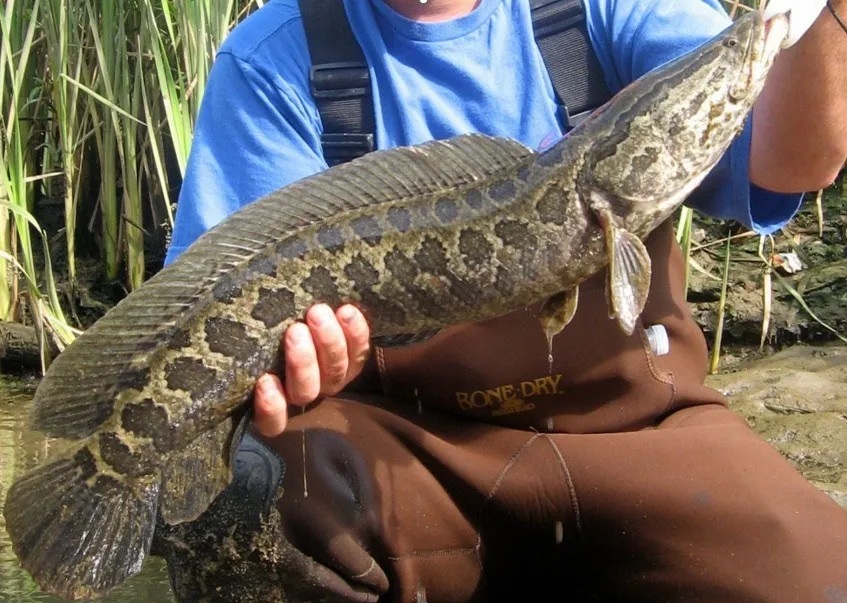
The northern snakehead, often dubbed the “Frankenfish” because of its snake-like appearance, sharp teeth and ability to survive out of water for extended periods, has become firmly established in parts of southeastern Pennsylvania.
The invasive predator has been documented in the Delaware, Schuylkill and Susquehanna rivers, along with connected creeks, tributaries and ponds, according to the Pennsylvania Fish and Boat Commission.
Last summer, according to USA Today, an angler caught one in Bucks County’s Neshaminy Creek, while another was found in the Schuylkill River near Phoenixville in neighboring Chester County in 2025, highlighting how close the species has come to Montgomery and Bucks counties.
Advertisements
Native to China, Russia and parts of eastern Asia, northern snakeheads were first discovered in the Mid-Atlantic in 2002 after appearing in a Maryland pond, according to USA Today.
Biologists believe the fish entered the United States through live food markets and the aquarium trade before being illegally released into local waterways. Since then, they have spread throughout the Chesapeake Bay and Delaware River watersheds, where they compete aggressively with native fish for food and habitat.
Advertisements
Adults prey on fish, frogs, crayfish and even small mammals or birds, while juveniles consume insects and other aquatic organisms that native fish also rely upon.
Credit: Murodjon Rakhmonov
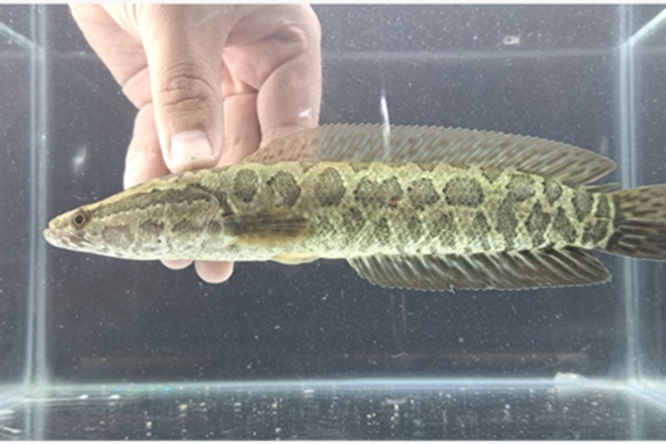
Adding to the fish’s fearsome reputation is its ability to breathe air. Snakeheads can survive for several days out of water if they remain moist and are capable of wriggling short distances across land in search of another body of water.
Thanks, evolution.
That means simply tossing one onto a riverbank is not enough, as it may make its way back into the water. Federal and state wildlife officials instead recommend killing the fish immediately by removing the head, cutting the gill arches or removing the internal organs.
Advertisements
Anglers may also place the fish on ice or in a freezer until it is dead before disposing of it or preparing it for consumption. In Pennsylvania, there is no size or creel limit for northern snakeheads, and transporting a live specimen is illegal, per USA Today.
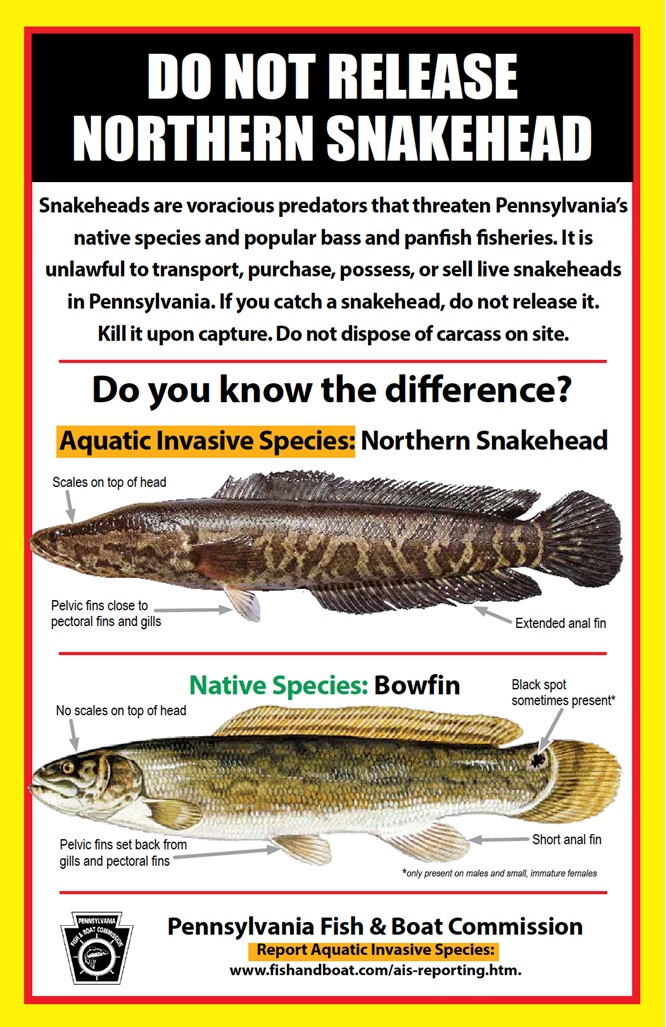
The Pennsylvania Fish and Boat Commission also asks anglers to report catches so biologists can better monitor the species’ spread. Officials caution anglers to positively identify a snakehead before taking action because it can resemble the native bowfin, which has no scales on the top of its head and should not be harmed.
Advertisements
While complete eradication of snakeheads from major waterways is considered unlikely, wildlife experts say public reporting and harvesting the invasive fish remain among the best tools for slowing its expansion and protecting native ecosystems.
The Game Commission and the Penn State Extension warn anglers not to get the northern snakehead confused with two other fish: the bowfin and the burbot. The bowfin is native to much of the Midwest and Eastern United States and can now be found in all the major river drainages in Pennsylvania, according to PSU. Bowfins has a shorter back fin and a lower jaw shorter than their upper jaw, as well as a rounded head and an eyespot on the tail.
Advertisements
The burbot is a bottom-dwelling predatory fish commonly found in Lake Erie and the start of the Allegheny River in northwest Pennsylvania. A burbot has a single whisker-like barbel on the bottom of its chin and have no canine teeth.
This article appears courtesy of a content share agreement between LevittownNow.com, NewtownPANow.com, and NewHopeFreePress.com and North Penn Now. To read more stories like this, visit https://www.northpennnow.com.

