Credit: Tom Sofield/LevittownNow.com
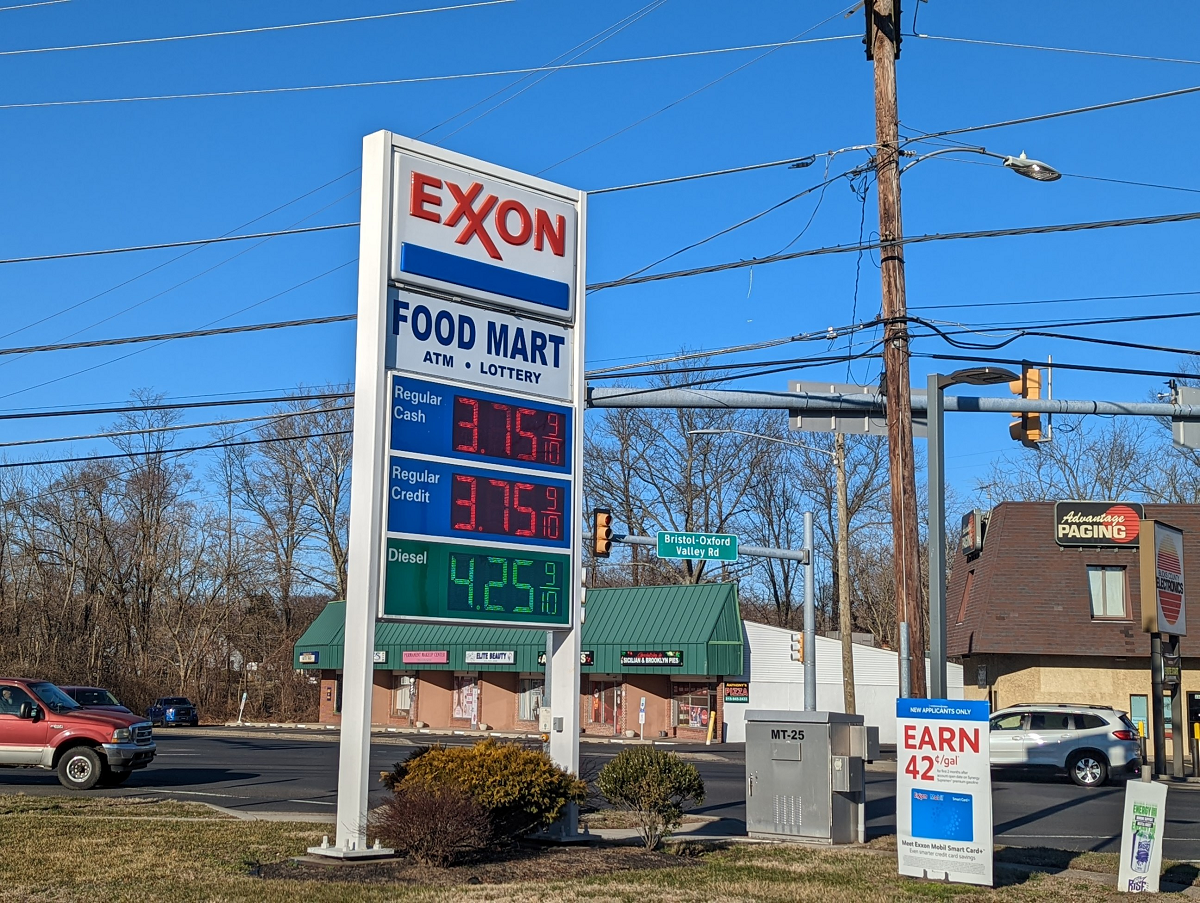
Gas prices in the Levittown area remain high, and Russia’s invasion of Ukraine could only lead to price increases.
Advertisements
According to AAA, the average Levittown-area gas price as of Monday morning was $3.77, a rise from $3.55 last month and $2.92 per gallon a year ago.
If you drive a vehicle with a 15-gallon gas tank, you have seen the cost to fill up go from $43.91 last year to $56.18 this week.
Gas prices range at local stations from $3.63 at one station in Middletown Township to $3.93 at a station in Bristol Township.
Advertisements
The national gas price average has risen by 7.5 cents over the past week and stands at $3.59 per gallon.
Experts at GasBuddy, a company that tracks gas prices, said fuel demand has been rising and crude oil prices have also been spiking.
Advertisements
The crude price increases are to blame on Russia’s invasion of Ukraine.
Russia is the globe’s second largest crude oil producer and is facing sanctions from numerous countries due to the war they started.
“The Russian invasion of Ukraine has sparked high level concern that oil production could eventually be stifled, or even sanctioned, from the world’s second largest oil producer, leading to less supply as demand grows. That possibility has pushed up the national average price of gasoline considerably in the last week, and the situation could worsen at any time, keeping gas prices elevated for the foreseeable future,” said Patrick De Haan, the head of petroleum analysis at GasBuddy. “In addition to the unstable situation with the Russian invasion, we’re also entering the time of year that seasonality pushes gasoline prices up by anywhere from 25 to 75 cents by Memorial Day. It’s simply looking like a perfect storm for motorists at the pump, with little to no relief anytime soon.”
Advertisements
A barrel of brent crude oil went from $94.14 to $101 over the past week. Brent crude refers to product from the North Sea of Northwest Europe.
The U.S. Department of Energy provided the below tips on saving gas:
Advertisements
DRIVING TIPS
• Minimize idling your car by turning off your engine when your vehicle is parked for more than 10 seconds. Idling can use a quarter to a half gallon of fuel per hour, depending on engine size and air conditioner use, adding up to three cents of wasted fuel a minute. In the winter, most manufacturers recommend driving off gently after about 30 seconds. The engine will warm up faster being driven, which will allow the heat to turn on sooner, decrease your fuel costs, and reduce emissions.
Advertisements
• Drive sensibly and avoid aggressive driving, such as speeding, rapid acceleration, and hard braking. Aggressive driving can lower your highway gas mileage by 15% to 30% and your city mileage by 10% to 40%.
• Avoid driving at high speeds. Above 50 mph, gas mileage drops rapidly. For every 5 mph above 50 mph, it’s like paying an additional $0.22 per gallon of gasoline.
Advertisements
• Reduce drag by placing items inside the car or trunk rather than on roof racks, which can decrease your fuel economy by up to 8% in city driving and up to 25% at Interstate speeds.
• Avoid keeping heavy items in your car; an extra 100 pounds in your vehicle could increase your gas costs by up to $.03 cents per gallon.
• Combine errands. Several short trips, each one taken from a cold start, can use twice as much fuel as one trip covering the same distance when the engine is warm.
Advertisements
• Check into telecommuting, carpooling, public transit and active transportation like bicycling or walking to save on fuel and car maintenance costs. Many urban areas provide carpool lanes that are usually less congested, which means you will get to work and home faster and more refreshed!
*All cost estimates assume an average price of $3.15 per gallon. Source: FuelEconomy.gov
Advertisements
CAR MAINTENANCE TIPS
• Use the grade of motor oil your car’s manufacturer recommends. Using a different grade of motor oil can lower your gas mileage by 1%-2%.
• Inflate your tires to the pressure listed in your owner’s manual or on a sticker that is either in the glove box or driver’s side door jamb. This number may differ from the maximum pressure listed on your tire’s sidewall.
Advertisements
• Get regular maintenance checks to avoid fuel economy problems due to worn spark plugs, dragging brakes, sagging belts, low transmission fluid, or transmission problems. Fixing a serious maintenance problem, such as a faulty oxygen sensor, can improve mileage by as much as 40%.
• Don’t ignore the check-engine light—it can alert you to problems that affect fuel economy as well as more serious problems, even when your vehicle seems to be running fine.
Report a correction via email | Editorial standards and policies