


By Andy Wallace of The Philadelphia Inquirer & Angela Couloumbis of Spotlight PA
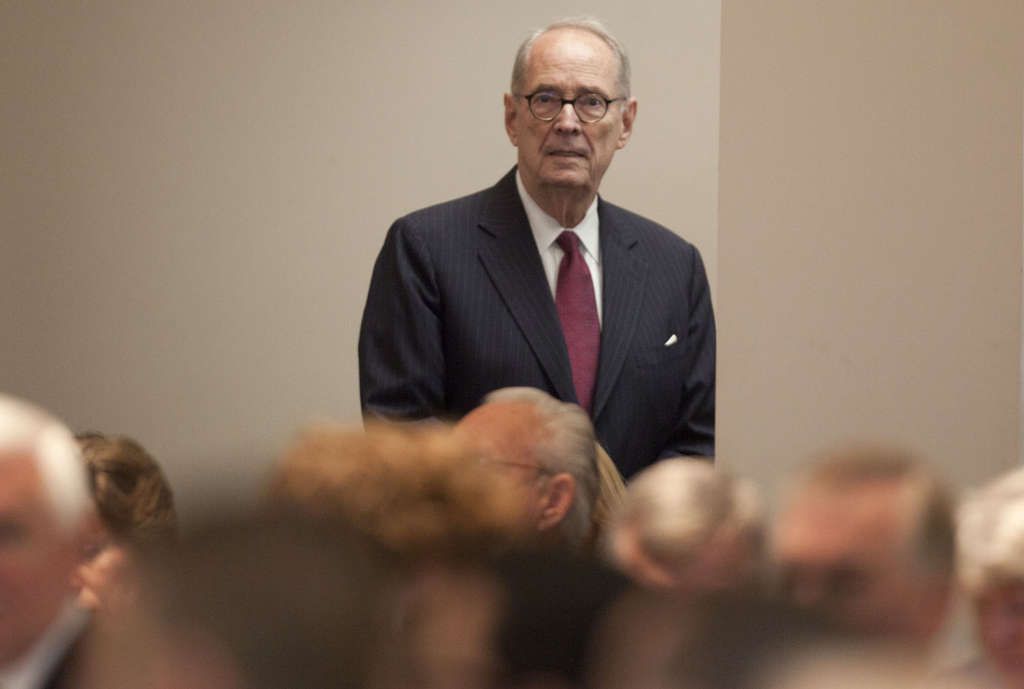
Credit: Spotlight PA
Richard “Dick” Thornburgh, an effective and respected two-term governor of Pennsylvania who later served a tumultuous three-year stint as U.S. attorney general under presidents Ronald Reagan and George H.W. Bush, has died at age 88.
His death was confirmed by his son David Thornburgh, who said the former governor died Thursday morning at Longwood at Oakmont, a retirement community outside of Pittsburgh. The family did not immediately note a cause.
Thornburgh was an able administrator whose priorities were as prosaic as fiscal restraint, political moderation, clean government, and, above all, efficiency.
In a tweet Thursday, former Gov. Tom Ridge said Thornburgh “led a life worth celebrating.”
“His public service was a model of integrity and character that anyone seeking office would be wise to follow,” Ridge continued. “A remarkable public servant and an even better man. Michele and I send condolences to Ginny and the Thornburgh family.”
Former Gov. Mark Schweiker, a Bucks County resident, called Thornburgh “a personal hero and a leader to emulate.”
“His passion for public service and the people of his beloved Pennsylvania was still obvious long after he left office,” Schweiker said in a statement.
Though Thornburgh’s years as governor made him some enemies, he left office in 1987 with high approval ratings: about 72% of 600 voters polled across the state gave him a favorable rating on his performance.
He had also earned the respect of some high-powered Republicans. In the late 1980s, he was the GOP’s knight in shining armor. President Ronald Reagan saw him as the perfect man to take charge of the Justice Department that had been demoralized under the leadership of Edwin Meese.
Thornburgh was not only interested in the office — one of the top jobs in Washington. He saw it, quite possibly, as the escalator to the White House.
Instead, it led to the political exit. Thornburgh was beaten by politically unknown Harris Wofford in the 1991 race to fill John Heinz’ U.S. Senate seat in Pennsylvania.
The defeat, unthinkable even in the weeks before the election, put an emphatic end to Thornburgh’s political career and to his dream of greater glory.
He grew up in Rosslyn Farms, an upper-middle-class village on a hill about seven miles from Pittsburgh, much younger than his three siblings — Jinny, 14 years older; Ann, 13 years older; and Charles, 11 years older.
Thornburgh was the son, grandson, and great-grandson of civil engineers, and, like his forebears, he earned an engineering degree at Yale University. But engineering was not what he wanted to do — not after getting a taste of the law in a course of business law for engineers.
Returning to his hometown, he enrolled in the University of Pittsburgh Law School in 1955 and at the same time, married his childhood sweetheart, Ginny Hooton, who worked two jobs to help pay his tuition.
After he graduated with highest honors in 1957, he worked for two years as legal counsel to the Aluminum Company of America and then joined the prominent Pittsburgh law firm of Kirkpatrick & Lockhart.
In five years, he and his wife had three sons — John, Peter, and David — and had moved out of their small apartment into a home of their own.
On July 1, 1960, tragedy ripped apart his world. His wife, Ginny, dropped him off at work and, heading home, was killed in a head-on crash with another car. Peter, an infant of four months, suffered permanent brain damage, and John and David were seriously injured.
’’That was the most significant event in my life,’’ Thornburgh told a reporter during his race for the Senate in 1991.
The accident ’’challenged me to expand my horizon, to do more than just try to be a successful lawyer and have a plot of grass and a home and a family.’’
In 1963, he met another Ginny — Virginia Walton Judson, an elementary school teacher with a graduate degree from Harvard University. Six months later, they were married and she adopted his children.
Three years later, they had another son, William, together.
Advertisements
Throughout his life, he was a family man. His idea of relaxation was to take in a Pirates game at Three Rivers or to gather the family for a homemade pizza with double cheese and pepperoni, some red wine or Iron City beer, and watch a rented movie.
Thornburgh was quick with a quip or pun, loved to mimic Bela Lugosi doing Dracula or to rehearse a scene from Bullwinkle, imitating Rocky the Squirrel, Bullwinkle the Moose, Natasha, and Boris — as he did to win his wife.
Advertisements
He dismissed the ability as ’’a family talent of zero worth.’’
Thornburgh was a serious man and he lived cautiously, meticulously and methodically, even when he was not at work.
Advertisements
He was a voracious reader and every time he put down a book, he marked the place in red ink and put the date in the margin. When finished, he added its title to an ever-growing list.
The enemy of clutter, he kept his desktop as well ordered as a geometry lesson. Pens and pencils, pink and white memos, newspaper clippings, his daily briefing book — all were neatly arranged and in their places.
Thornburgh accepted his rage for order.
’’The more you establish methods and procedures, the less you have to worry about how to do something and the more you can focus on what to do,’’ he said in 1991. ’’Maybe some of that is a little bit excessive, but you can’t change your instincts.’’
Advertisements
He also had an instinct for politics.
His first stab at public office was in 1966, when he ran for Congress as a moderate Republican. He was for laws extending civil rights and voting rights, he favored better relations with China and criticized the U.S. role in Vietnam.
He lost badly, but he remained active in the party and in local organizations, including the ACLU and NAACP. He worked for legal aid for the poor and for increased aid for the disabled and was a delegate to the 1967-68 convention that rewrote the Pennsylvania state constitution.
In 1969, he was named U.S. attorney in Pittsburgh by President Richard Nixon and quickly notched a reputation as being tough on racketeers and corrupt government officials. In 1975, President Gerald Ford called him to Washington to be chief of the Justice Department’s criminal division.
He returned to Pennsylvania as a candidate in 1978, when he defeated seven others to win the GOP nomination for governor. He followed that up by upsetting the favorite, Democrat Pete Flaherty, the popular mayor of Pittsburgh.
The eight years he was governor were not especially troubled times in Pennsylvania. He was praised for his handling of the near meltdown at Three Mile Island nuclear plant, a crisis that began only 72 days after he took office, and criticized for cutting off welfare benefits for thousands.
He was sometimes seen as arrogant — like when he told a young single woman on welfare, “Things are tough all over,” when she told him how hard it was to find work.
Advertisements
But in general, the U.S. economy was healthy and state government sailed smoothly under Thornburgh’s hand. His administration was a reflection of his personality. No innovator, he was content to run things efficiently as possible and keep a keen eye on the bottom line.
’’He will be perceived as a good governor by the people,’’ said then Senate Democratic leader Edward Zemprelli of Allegheny County as Thornburgh left office. ’’My own perception is that he had the opportunity for a great deal of accomplishment but was reluctant to do anything for fear of making a mistake.’’
Thornburgh was credited with improving the state’s roads and ending the corruption and sloth that had characterized the Transportation Department before him.
On welfare, he drafted legislation that lopped 60,000 people from the public assistance rolls and ’’created a whole new class of poor people — the homeless,’’ according to Democratic Sen. Roxanne Jones, who was a welfare recipient when the law passed in 1982.
’’He has created a climate against poor people and made it difficult to get any programs to help them. I’m very bitter about it,’’ Jones said then.
His legislation in effect limited public assistance to three months a year for certain able-bodied people. He later vetoed a bipartisan effort to restore benefits to pregnant women and people with mental or physical handicaps.
Asked by a reporter to pinpoint his biggest accomplishment as governor, Thornburgh said the state’s economy ’’is the one that’s key to me.
’’When we took office, this was a state that was overcommitted to declining smokestack industries and with no strategy whatsoever to develop a more future-oriented economic base,’’ he said then. ’’ We’ve seen, by every indicator and every assessment, a truly dramatic turnaround.’’
He took credit for the lowered unemployment rate — then 5.1 percent, its lowest point in 14 years — for the budget surplus of $200 million and for state leadership in the start-up of new businesses.
But he had many critics, who said his economic gains were nothing more than public relations.
’’It has been government by news manipulation, with as much depth as a piece of tissue paper, and as much substance,’’ said Sen. Vincent J. Fumo of Philadelphia, then the ranking Democrat on the Appropriations Committee.
But in 1987, the U.S. economy was healthy, there had been few scandals during his administration and he had worked to set up a trim, waste-free government. He was even able to lower some taxes he had raised earlier.
And so, when he left office to take a job as director of Harvard University’s Institute of Politics, he was seen as a successful and popular governor, and a good candidate for a role on the national stage.
The call came in 1988, when Reagan called him to Washington to straighten out the Justice Department, then heavily criticized and demoralized under Edwin Meese, who was under investigation for benefiting from the success of Wedtech Inc., which won U.S. military contract through favoritism.
Thornburgh could do nothing right in Washington.
In three years, he spent most of the political capital he had stored up in years as a corruption-busting U.S. attorney, as a penny-pinching governor, and as an astute and moderate politician.
He caused resentment by taking with him to Washington three former aides from Harrisburg. The three became his closest advisers, limited access to the attorney general and to information.
He battled independent counsel Lawrence Walsh over the release of classified documents in the Iran-contra trials and so was seen more as a defender of the White House than a federal prosecutor probing for facts.
Though he was given credit for sending boardrooms full of white-collar criminals to jail, he was taken to task for failing to aggressively investigate two major scandals — the Bank of Commerce and Credit International and the massive bank fraud that brought about failure of the savings and loan industry.
“… We wish he had left a truer stamp of himself on the office, and persist in thinking that Dick Thornburgh had much more to offer in government than he gave,’’ the Washington Post editorialized on Aug. 13, 1991.
Thornburgh appeared to move from the center to the right on the GOP political spectrum, was criticized as partisan, secretive and high-handed and failed to recognize political decorum in dealing with Congress.
In defending his three-year term, he said any attorney general who remains popular would not be carrying out the office’s duties in a responsible fashion.
’’Probably for better or worse, I do pass that test of responsibility in office,’’ he said. ’’I have more than once been a popular target for popular commentators, but I can abide by that distinction, secure in the knowledge that we have done our level best to call ‘em as we see ‘em, without fear or favor from any quarter, and to follow the evidence wherever and to whomever it might lead.’’
This story will be updated.
Spotlight PA is an independent, non-partisan newsroom powered by The Philadelphia Inquirer in partnership with PennLive/The Patriot-News, TribLIVE/Pittsburgh Tribune-Review, and WITF Public Media. Sign up for our free newsletters.
100% ESSENTIAL:Spotlight PA relies on funding from foundations and readers like you who are committed to accountability journalism that gets results. Become a member today at spotlightpa.org/donate.

