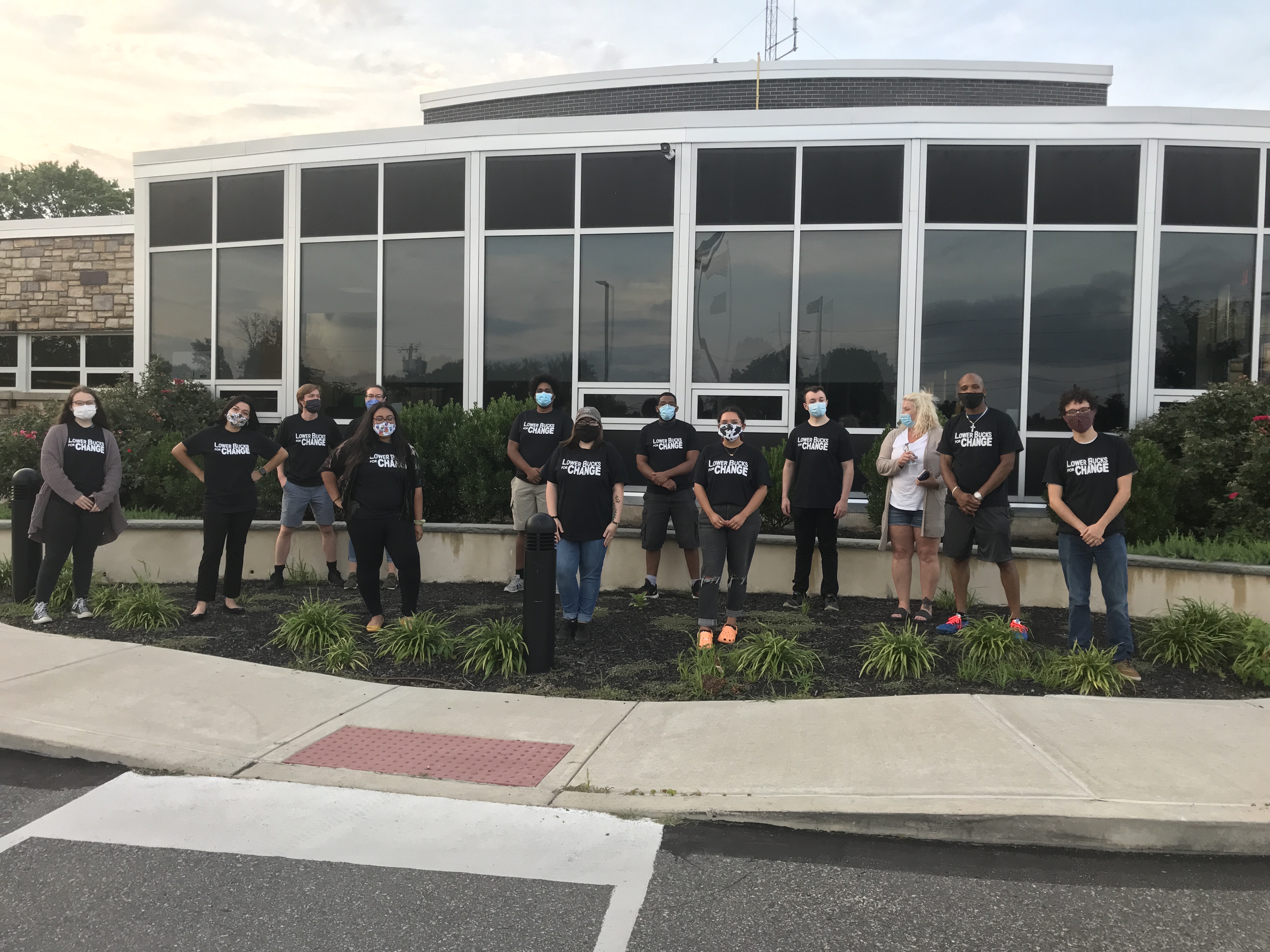
Credit: Hal Conte/LevittownNow.com
A coalition created amidst nationwide demonstrations surrounding race and social justice, Lower Bucks for Change is creating waves in Bristol Township as members have made their voices heard.
The group’s early focus has been on Bristol Township, one of the largest and diverse municipalities in the county.
Advertisements
Organized by recent local high school and college graduates, the movement’s membership argue Black, brown, and immigrant students and residents are poorly served by area schools and a township budget where more than half of total expenditure is used to fund the Bristol Township Police Department.
“We wanted to connect to people at our age. We hope we can use this as a resource for electoral and political changes as well as policy change,” said Vincent Montoya, a 22-year-old graduate of Truman High School and a member of Lower Bucks for Change.
Montoya helped found the group following the death of George Floyd and the ensuing movement.
Advertisements
“The night the riots began we feel like, ‘what is going on here?’ We couldn’t find a local Black Lives Matter (BLM) chapter around here. I care a lot about criminal justice reform, so this was a natural impetus to get started in our own community … Young people tend to leave [Bristol] because our political and cultural structures don’t appear to have the potential for growth,” he said.
A critical reason for this, Denise George, a 23-year-old graduate of Harry S. Truman High School, said is the unrepresentative nature of the township council and other local bodies, which are almost entirely white.
Advertisements
“Our political leaders have a completely distorted perspective of what we want,” she said. “Our goal is to mobilize people to create a safe space for all residents.”
One major goal of Lower Bucks for Change is education reform.
“We have students from all races, but those students aren’t celebrated the same way we celebrate white culture and white children” George said. “We see white people in every textbook we see. What are the names of the schools? Everything around us is celebrating white culture. We do have some ideas for the curriculum, we created a portfolio of intersectionality, US foreign intervention, Latinx history, indigenous history, LGBT training, legal rights, voting, all of those will make our community more socially confident.”
Advertisements
“When we talk about history, we leave the present in its own bubble. We don’t make connections to the present. There’s constant backlash we see because people haven’t had the proper education to fully grapple with these issues. I don’t think it’s worthwhile to keep abridging history,” said Fernando Coplin, a 21-year-old graduate of Truman High School.
Topics the group would like to see addressed in a new curriculum include the Black Panthers and other Black liberation groups, racism in Franklin Roosevelt’s New Deal, and the Tulsa race massacre.
Advertisements
“There’s a lot of whitewashing, white leader complex. We see teachers who are making strives individually, but they aren’t receiving any support,” George said. “Why is African-American history only taught for two weeks? We expect resistance, we have no belief in convincing or changing the minds of the people who don’t want to change.”
George also would like to see Truman recommend historically black colleges and universities (HBCU) to black students who show promise.
Advertisements
“Never once was an HBCU recommended to me. I was blind about it until I actually made my decision,” she recalled.
Lower Bucks for Change’s goal is to have an articulated curriculum which parents can view.
Advertisements
Activists from Lower Bucks for Change met with the chair of the social studies department and two other teachers to try to gain support for curriculum changes over the summer.
A crucial component of their cause is calling for reforming police, including through cuts to the police budget.
“The police play too big a role in our society right now,” Montoya said. “The majority of people think we should stop arresting people for having weed. It’s unacceptable we don’t have data on racial arrest rates. If you took less than 15 percent of the police budget, every student could meet with a social worker each month. It’s pretty uncontroversial stuff we’re putting forward, when more than half of the general fund is spent on policing in Bristol.”
Advertisements
Montoya said members of the group plan to attend every township council meeting until the budget is passed in December.
“We don’t need to do any persuading. It’s clear they are not allocating the money correctly,” he said.
Advertisements
Some members of the council, including President Craig Bowen, have said they were open to meeting with the group. Members of the Lower Bucks for Change said they were hoping for more engagement in the coming months.

Councilperson Patrick Antonello applauded the group in June for coming to the meetings and making their voices heard.
“We’re concerned about every single citizen in Bristol Township, and we’ll make sure you have a voice,” Antonello said.
Advertisements
The council welcomed the group and thanked them for coming out in June, but the July meeting showed that it was clear that the group could face a bit of an uphill battle.
In July, members of the group came before Bristol Township Council to make their voices heard and advocate for their goals, including making Bristol Township a so-called ”sanctuary city,” examining police spending, and support for easing rules for marijuana.
“You must be talking about a different community,” said Council Vice President Cynthia Murphy in an exchange with the group. “Did you just hear our meeting? Our police are dedicated to our county, serving it. Everyone comes together, it is a very diverse and welcoming community for the majority of the residents. We are very diverse. For the most part, everyone gets involved.”
Advertisements
The group intends to keep going to council meetings and looking at how residents are treated.
Even though the group largely focuses on minorities, “this social movement affects the majority,” said Miroslava Vazquez, 22, who studied engineering at Bucks County Technical High School and went to the University of Pittsburgh. “It’s not just us as we see across the nation.”
The group has requested community town hall meetings and has allied with the similar Bensalem United.
Report a correction via email | Editorial standards and policies
Advertisements