


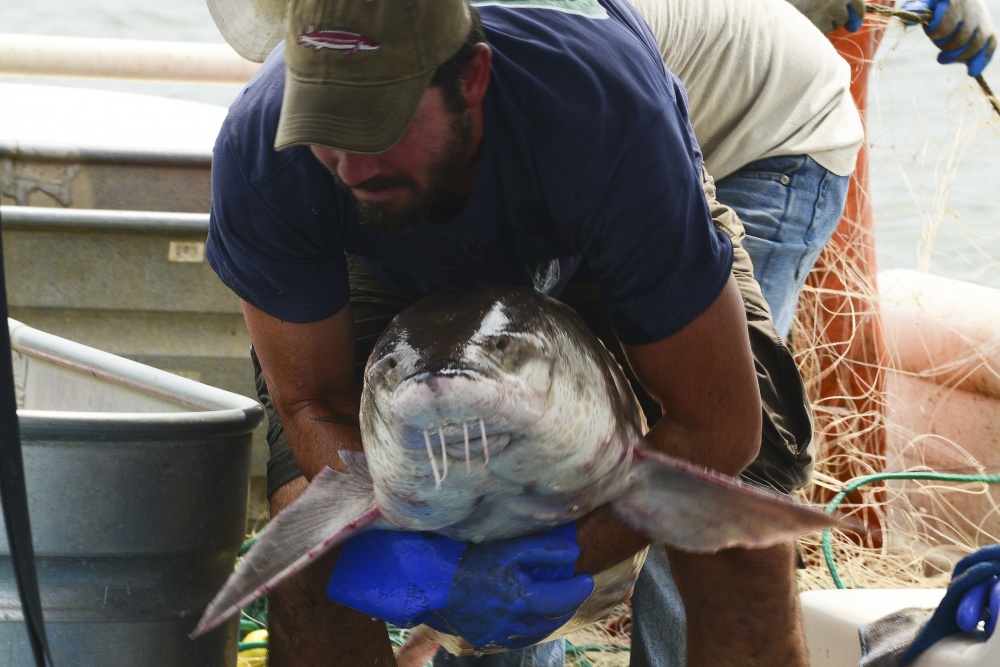
Credit: Senior Airman Kimberly Nagle/U.S. Air Force
A new designation from federal authorities is aimed at restoring the population of the endangered Atlantic sturgeon in our region.
The National Marine Fisheries Service, also known as NOAA Fisheries, announced that 31 waterways up and down the Atlantic coast received protective designation as part of an “important step” to ensuring the recovery of Atlantic sturgeon, a fish that can live up to 60 years and grow to weigh hundreds of pounds and up to 14-feet-long.
Advertisements
Under the new designation, the Delaware River between Morrisville and the Delaware Bay has been named a “critical habitat designation” for the fish. While this does make it a sanctuary for the Atlantic sturgeon, federal agencies looking to work in the river will have to consult NOAA Fisheries officials.
Fishing of the Atlantic sturgeon remains out of bounds due to a 40-year moratorium placed in 1998.
The new designation means work to deepen the Delaware River channel will have to be run by NOAA Fisheries staff in order to protect the endangered Atlantic sturgeon.
Advertisements
“Our focus now will be on providing guidance to federal agencies to help them carry out their actions efficiently and effectively while minimizing impacts to habitat that is critical to these endangered and threatened populations of sturgeon,” said Samuel D. Rauch III, deputy assistant administrator for regulatory programs at NOAA Fisheries.
Maya van Rossum, the Delaware Riverkeeper, was pleased with the designation and called the move “important and a relief.”
Advertisements
“The Delaware River population is the most at risk in the nation with less than 300 spawning adults of this genetically unique line. The estuary is vital for Atlantic sturgeon spawning, reproduction, growth and survival. We only hope National Marine Fisheries Service will now use this designation to better protect this vital habitat for the species,” she said.
A NOAA Fisheries information page notes that the Atlantic sturgeon has faced numerous challenges that have led to large declines in population. Commercial fishing, habitat loss from dredging, saltwater intrusion, pollution, silt from the coal industry and boat strikes have led to the decline and inability to recover. The fish was harvested largely for its eggs to be used as caviar last century.

