


By Rachel Martin | PAindependent.org
A Pennsylvania lawmaker wants to give hospitals the power to box out new competition.
Advertisements
State Rep. Florindo Fabrizio, D-Erie, is asking fellow lawmakers to co-sponsor his proposal to resuscitate Pennsylvania’s long-dead certificate of need program. Under CON programs, proposed medical facilities must prove to state regulators there’s need in the community or they can’t open. Existing medical facilities get to participate in that assessment — objectively, of course.
So far, Fabrizio’s request has drawn zero co-sponsors. Critics of such CON programs say that’s good news.
Advertisements
“Why would you do that, instead of trying to move forward?” Richard Bloxdorf asked during an interview with Watchdog.org. He’s the administrator for Village SurgiCenter of Erie, an outpatient surgery center.
Such facilities have sprung up over the past 20 years, some with narrow specialties, like eye surgery or foot and ankle surgery. This expansion seems to worry Fabrizio.
Advertisements
It isn’t surprising that artificial barriers to entry decrease consumer choice and inhibit innovation, but supporters have argued there’s a trade-off: CONs, they say, would cap the costs of new technology. Several studies over decades have shown the opposite. Even the federal government, no fan of deregulation, has concluded “CON programs generally fail to control costs and can actually lead to increased prices.”
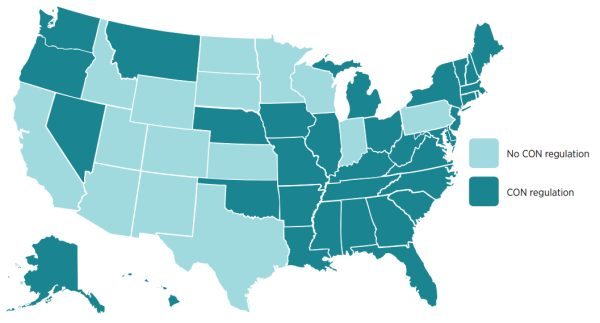
Using Kaiser Family Foundation data, free-market policy analyst Jordan Bruneau calculated that states with CON programs had average per capita health care costs 11 percent higher than states without them: $7,230 compared to $6,526.
“You’re stifling competition when you (have those regulations),” Bloxdorf said. “You decrease competition and increase costs.” He added that these independent facilities also have lower infection rates and, unlike most hospitals, which are technically nonprofits, “we pay taxes.”
Advertisements
Forty-nine states ended up with CON programs after a 1974 law tied federal funding to them. But that law was repealed in the ’80s, and federal agencies since have been urging states to kill the programs.
The Federal Trade Commission has remained at the forefront of criticism, as recently as this month saying that CON programs begin with “laudable goals” but ultimately “prevent the efficient functioning of health care markets in several ways that may undermine those goals.”
Advertisements
Bloxdorf is confident in letting the market determine the need for facilities like his. He’s seen the results of companies that don’t do their homework well: “Market forces take companies down all by themselves.”
Fabrizio did not respond to emails or calls for comment about his proposal.

