


By Andrew Staub | PA Independent
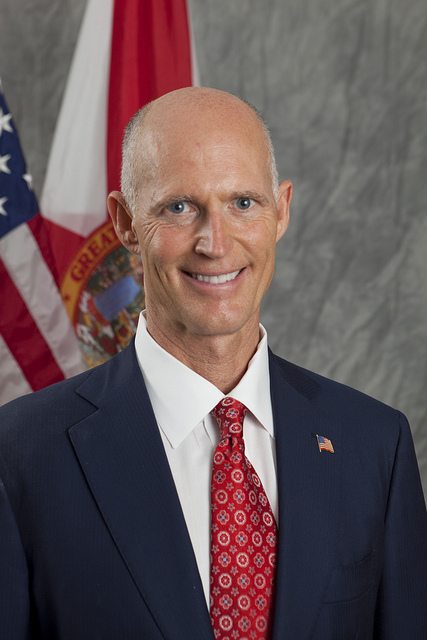
Credit: State of Florida
Florida’s Gov. Rick Scott will visit Pennsylvania next week in an attempt to lure job creators south, and policymakers here have given him a heckuva weapon to use against the Keystone State — an onerous corporate net income tax.
Advertisements
At 9.99 percent, Pennsylvania has the second-highest corporate tax rate in the country. Only Iowa’s 12-percent rate is higher, though corporations there can deduct federal tax liabilities from their state tax returns, lending some truth to statements that Pennsylvania has the highest corporate tax, said Scott Drenkard, an economist with the nonpartisan Tax Foundation.
“It’s important to remember that if you take 9.99 percent and add it to the already uncompetitive federal system on the corporate tax, you get a rate of 44.99 percent, which is astonishing,” Drenkard said. “That is the highest rate in the world if you’re paying into Pennsylvania when you add up the federal and state corporate tax.”
Businesses have long complained about the corporate net income tax, and Scott’s visit has lawmakers again examining how their policies can affect job creators.
Advertisements
Scott will make his pitch at the same time Pennsylvania Gov. Tom Wolf, a Democrat, is touting raising the minimum wage, calling for a severance tax on the natural gas industry and perhaps pursuing a progressive personal income tax that would make the rich pay more.
State Rep. Kerry Benninghoff, a Centre County Republican who chairs the House GOP Policy Committee, said he thinks discussions about those sorts of policies have allowed Scott to see Pennsylvania as a “target.”
Advertisements
“You can’t be taxing the producers and your manufacturers to subsidize a government that’s got to get their spending under control,” said Benninghoff, who invited Drenkard and several business leaders to testify at a Wednesday committee hearing about the state’s business climate at York College.
The objective was to focus on what Pennsylvania is doing correctly and what it could improve to make the state more attractive to business, Benninghoff said. There are indications there’s much work to be done.
Advertisements
Florida, the sunny haven with no individual income tax, has Pennsylvania beat in both indexes. Scott, a Republican, wants to take advantage.
“I am leading a delegation to Philadelphia to send a message to all Pennsylvania job creators and families that we want you to keep more of the money you make because we understand it’s your money,” Scott said last month in a written statement announcing the visit.
Advertisements
Competition between states is nothing new, a fact not lost upon groups representing manufacturers, corporations and small businesses. Scott’s bold proclamation, though, has given his impending trip a different feeling.
Alex Halper, a lobbyist for the Pennsylvania Chamber of Business & Industry, lauded the state’s efforts to address lawsuit abuse and the repeal of the inheritance tax for farms and small businesses. The unpopular capital stock and franchise tax is also set to expire this year.
Advertisements
Those changes, though, aren’t happening within a vacuum, Halper said. While the business community has been feeling more optimistic, it’s still cautious, he added.
“The prospect of new or higher taxes, additional mandates on employers, higher costs to do business and just in general a concern that the employer perspective is getting lost during some of these policy deliberations just are keeping a sense of trepidation within the business community,” he said.
Advertisements
Businesses are even keeping a keen eye on Pennsylvania’s tenuous public pension system, which carries $50 billion in unfunded liabilities. That includes Utz Quality Foods, the largest independent privately owned snack brand in the country. The company is famous for its potato chips and calls York County home.
That state’s taxation problems will worsen if Pennsylvania pays down the debt on the back of businesses, said Jeff Martin, executive vice president of sales and marketing for Utz.
“We think it’s an underlying case for increased taxation to try to cover this pension liability,” he said. “That worries us. It’s an unpredictable cost that we think we’re faced with.”
Advertisements
While cutting taxes, such as the corporate net income tax, might be a hard sell with the state facing a projected deficit of more than $2 billion, Drenkard suggested ending special credits could help lawmakers reduce the burden on business in a revenue neutral way.
State Rep. Stephen Bloom, R-Cumberland, favors eliminating special credits and closing loopholes in exchange for a broadly based lower tax rate. Pennsylvania needs to start tightening its budget so it can compete with states looking to poach job creators, he said.
Advertisements
“You have to look at tax policy in a dynamic context,” he said. “If we simply raise rates or keep unmanageably high rates in place, we gradually erode our base of employers and taxpayers and that puts us into a vicious cycle of having to raise rates even higher to sustain revenues, all of which is ultimately a losing game.”

