



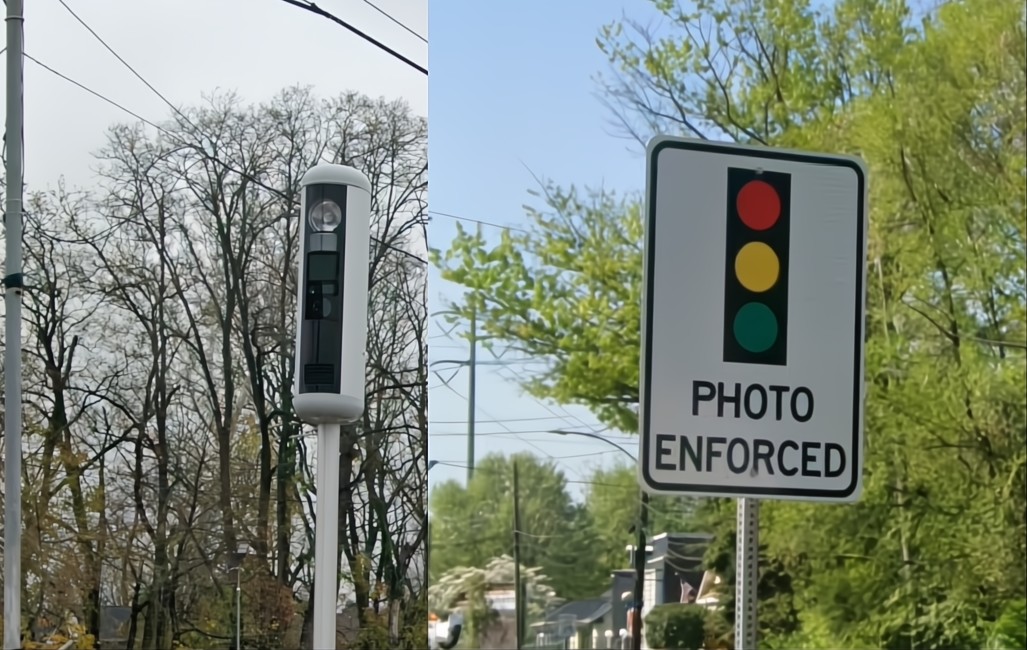
Credit: Google Maps
Red light cameras are showing early signs that they may be changing driver behavior and reducing serious crashes in Bristol Township, but police Chief CJ Winik is not yet ready to declare victory.
Advertisements
Winik presented to council on Oct. 15 with roughly the first full year of data from the township’s automated red-light enforcement program, including citation trends, police review procedures and preliminary crash numbers.
He said some monitored roadways have experienced nearly 40% reductions in serious crashes, but others remain the status quo. The cameras operate along Route 13, or Bristol Pike, at Green Lane and Edgely Road, and along Route 413 at Western and Wharton roads.
“One year of data is not sufficient enough,” Winik cautioned.
Advertisements
Asked directly whether fatalities had dropped at the intersections, Winik said the numbers appear promising but stopped short of attributing the change to cameras.
“It would be misleading to say we’ve stopped fatalities and serious crashes,” Winik said.
PennDOT determined the locations of the cameras based on traffic and crash data, according to Winik.
Advertisements
He said Route 13 has seen fatal crashes, while the Veterans Highway (Route 413) area experiences heavy traffic, speeding and drivers passing school buses displaying red lights.
The cameras are intended to change behavior beyond simply stopping drivers from running red lights.
“As people in our community know there’s a red light camera up, they get their eyes up, not on the phone, not grabbing for a drink,” Winik said.
Advertisements
When a vehicle enters an intersection after the light turns red, the system captures the event and it undergoes an initial review by vendor Sensys Gatso before being forwarded to Bristol Township Police. The photograph and video are reviewed by an officer, before deciding whether a violation should be issued.
Winik said officers are instructed to use discretion, particularly when a driver’s actions appear to be a minor mistake rather than a dangerous violation.
“If somebody does make a mistake, we’re not here to give them a ticket,” he said. “It’s about awareness and traffic safety.”
Advertisements
Police also review right turns on red.
A driver who stops completely and makes a legal right turn will not be cited unless right turns are prohibited at the intersection.
Winik said officers have also exercised discretion on rolling right turns, although drivers traveling about 15 mph through the turn can expect a citation.
Violations carry a $100 civil fine. They do not result in driver’s license points, are not criminal offenses and do not affect automobile insurance, according to Winik. He said police sometimes dismiss violations during that process after speaking with drivers, although repeat offenders should not expect the same consideration.
Advertisements
The department’s review system also caught a technical problem this summer that caused police to stop issuing citations temporarily.
Winik said officers noticed that a yellow light interval had dropped to 3.9 seconds. The automated enforcement program requires a four-second yellow light.
Advertisements
“Our officers did not approve those citations,” Winik said.
Police contacted the camera operator and state officials and stopped issuing affected citations until the timing could be corrected.
Winik said the incident demonstrates why human review remains a central part of the program.
Advertisements
The number of citations climbed after the cameras became operational in 2025, reaching roughly 2,500 to 3,000 during some late-2025 periods before declining. Part of that decline reflects changes in driver behavior, Winik said, while police are also rejecting more borderline cases.
The cameras cost the township nothing directly, according to Winik.
Advertisements
Officer time spent reviewing violations is tracked and reimbursed through program proceeds, while remaining money is directed to PennDOT for roadway improvements.
“This is not about building revenue for the town,” Winik said. “We get nothing.”
The chief said technology has become particularly important because Pennsylvania municipal police departments cannot use radar for speed enforcement, leaving officers dependent on older methods involving marked roadway distances and timing devices.
Advertisements
Traffic complaints are among the department’s most common calls, he said, and staffing an officer at every problem intersection isn’t realistic.
The department intends to continue collecting crash data before reaching conclusions about whether cameras are producing sustained reductions in serious collisions.

