
By Whitney Downard | Pennsylvania Capital-Star
Credit: Whitney Downard/Pennsylvania Capital-Star
Last year, Family Practice and Counseling Services Network hired a psychiatric nurse practitioner to assist with the mental health needs of a “medically underserved” clientele.
Advertisements
But CEO Emily Nichols said it would be nearly six months before they saw a single patient at the Philadelphia Federally Qualified Health Center, since Pennsylvania requires nurse practitioners (NPs) to practice underneath a physician.
“And that’s just one psych NP. We could hire four more for the need we see, but we don’t have the resources and we don’t have the collaborating physicians,” Nichols told the Capital-Star. “And we have to pay for (collaborating physicians). We’re a community health center; we’re operating on a pretty thin margin.”
Credit: Center for Rural PA
Pennsylvania is what’s known as a “reduced practice state,” meaning that Certified Registered Nurse Practitioners must have a written collaborative agreement with a licensed physician to work. But attempts to advance legislation changing that rule have repeatedly failed, despite broad, bipartisan support.
Advertisements
The Pennsylvania Coalition of Nurse Practitioners notes that NPs can assess patients, diagnose conditions, order and interpret tests, develop treatment plans, prescribe medications and coordinate patient care — with an agreement for an overseeing doctor to consult, review records and charts and more.
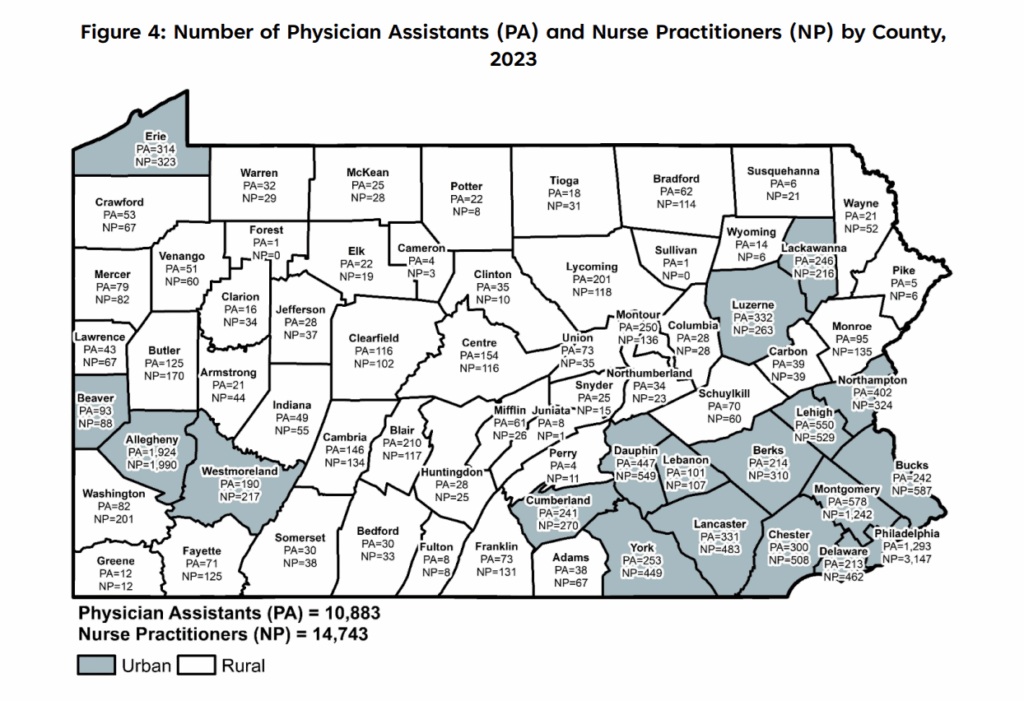
Other states don’t have the same restrictions, including nearly all of Pennsylvania’s neighboring states. Supporters argue that NPs can fill in gaps as the number of commonwealth physicians declines, particularly in rural areas. In contrast, the number of NPs has been increasing in both urban and rural settings.
Advertisements
More than two dozen states are more flexible, as well as the Veteran Affairs health system. Rep. Nancy Guenst (D-Montgomery), a U.S. Army veteran, said, “If it works for our veterans, it can work for Pennsylvanians.”
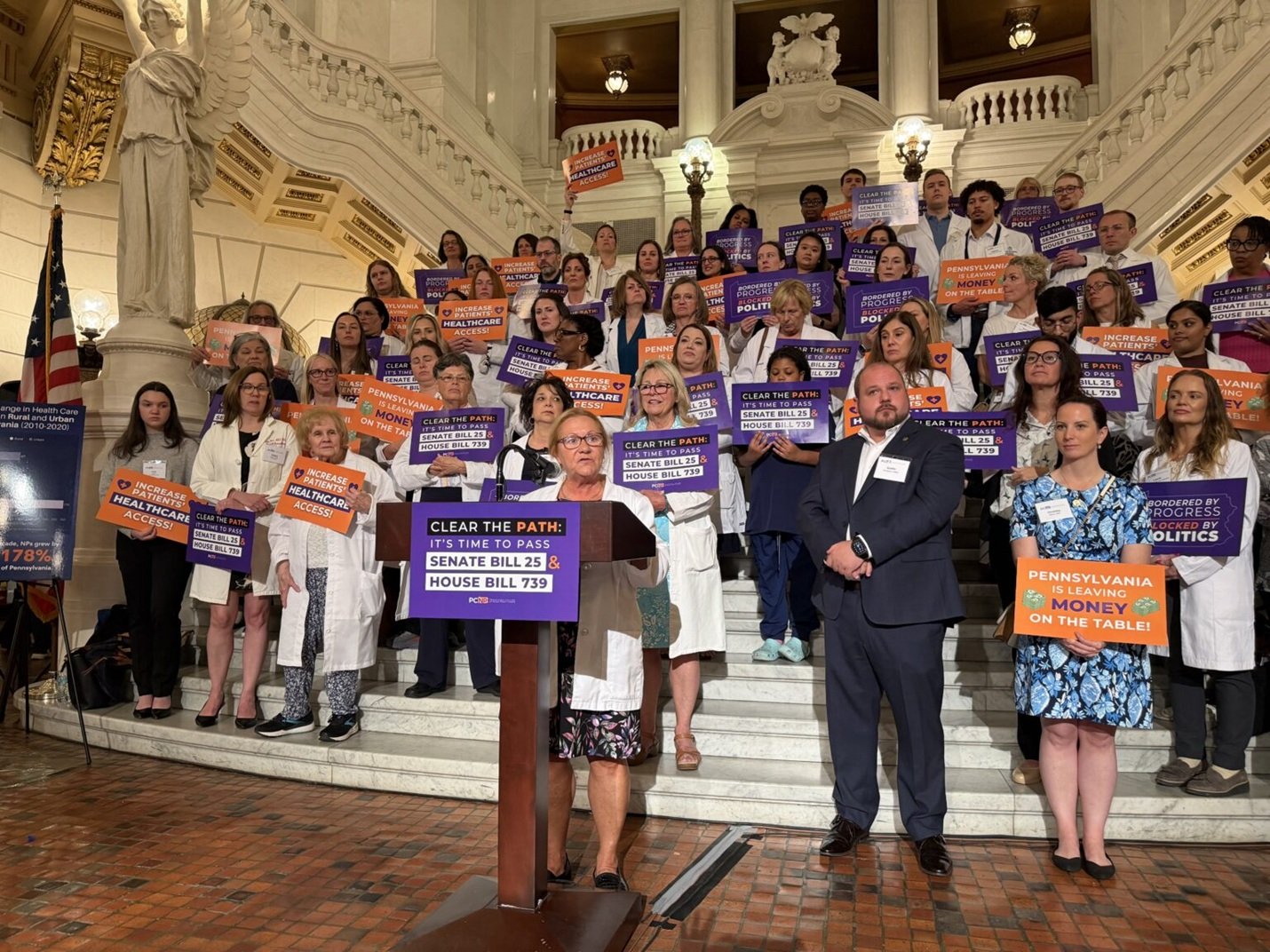
“We do not have to guess whether this works,” Guenst said before a crowd of NPs in the Capitol on Monday. “Study after study has shown improved access to care, particularly in rural communities, with no reduction of quality or patient safety.”
Nichols, who’s based in Philadelphia, called her center “lucky” for having a supportive collaborative partner, adding that many other centers don’t have NPs at all because of that requirement. But day-to-day, doctors still need to sign off on routine items, such as specialized shoes for diabetic patients.
Advertisements
“When a nurse practitioner is seeing you as a patient, they could easily just sign that form and you could go get what you need,” said Nichols. “But there’s a barrier to do that.”
Support in the General Assembly
Sen. Camera Bartolotta (R-Washington) started her current term in 2018, and has introduced Senate Bill 25 every year to expand the practice of NPs. Despite that consistency, even keeping the same bill number across two administrations, it has yet to make it to a governor’s desk.
Advertisements
Bartolotta’s first version notes that 21 other states and the District of Columbia allow NPs “full practice authority.” Today, that number is 28.
“I do not want to see 49,” Bartolotta said at Monday’s rally. “We hit a crisis point a long time ago. It’s not, ‘This could be good someday.’ That day is behind us … What the heck are we waiting for?”
Advertisements
In the early years, NP legislation passed the Senate with only a handful of detractors, but didn’t get a House hearing at least four years in a row. Now, the hesitation appears to come from her own chamber’s leadership, as House Minority Leader Jesse Topper (R-Bedford) advanced his own pilot version out of the House chamber when he was a rank-and-file member in 2020.
This year’s House version, House Bill 739, is sponsored by Guenst. Neither Bartolotta’s Senate measure nor Guenst’s bill have yet had committee hearings.
Advertisements
One of the biggest opponents to expanding the scope of NP duties is the Pennsylvania Medical Society, whose opinion Bartolotta said, “has carried significant influence in Harrisburg and has contributed to delaying the legislation despite its broad bipartisan support.”
The Medical Society didn’t immediately return a request for comment Monday, but generally opposes expanding duties for non-physicians, including pharmacists. Online, the body points to studies showing that non-physician led care increases health care costs, asserting that, “Optimal patient care is most effectively delivered through health care teams.”
“We’re not trying to replace doctors,” Bartolotta emphasized. “(NPs) are in partnership with them, able to fill in all of those gaps that just keep turning into chasms. They’re here to fill the gaps of really good, quality healthcare for people who desperately need it.”
Advertisements
In contrast to ongoing efforts focused on educating new providers, Bartolotta noted that NPs “are ready to go” now at no extra cost to the state, and can refer high-level cases to doctors when needed.
Some Pennsylvania NPs have secured jobs across state lines, like addiction specialist Justin Rohrback. He started his practice in Maryland instead of his York County hometown. He said that disruptions in physician oversight not related to patient care in a previous job threatened to undo recovery treatment plans, and were only averted “at great (financial) cost.”
Advertisements
“When we discuss healthcare policy … we need to remind ourselves what these numbers represent. These are not just prescriptions. They’re mothers, fathers, sons, daughters, neighbors and friends,” said Rohrback. “We are losing qualified healthcare providers due to regulatory red tape.”
Leaving money on the table?
Licensed NP Rep. Tarik Khan (D-Philadelphia) jokingly noted that few things had such broad appeal that they’d attracted support from political opposites like President Donald Trump and former President Barack Obama.
“We have Democratic support. We have Republican support. We have Senate support. We have House support,” said Khan. “Let’s get this done.”
Advertisements
That endorsement is reflected in the federal Rural Health Transformation Plan’s application process. The state got $193 million last year from the program, which is designed to offset the billions in Medicaid losses over the next decade.
Despite having the third-largest rural population in the country, Pennsylvania’s per-resident award was just $78, compared to an average of $157 nationwide. A handful of scoring mechanisms work against the commonwealth, including its status as a “reduced practice state” for NPs.

Credit: PA Internet News Service
The program application places an emphasis on states that “help rural providers practice at the top of their license,” naming both NPs and physician assistants as examples.
Advertisements
“We are running out of time to pass the full practice authority before the state submits its (next) application to the federal government,” said Sheilah Yohn, the president-elect of the NP coalition.
“We must be able to clearly state that we are a full-practice state,” before the Aug. 30 deadline, she continued. In some commonwealth counties, she added that NPs are the highest-level healthcare provider, but must coordinate with a physician outside of their community to deliver care.
“Full practice is a win for everyone,” Yohn concluded.
Pennsylvania Capital-Star is part of States Newsroom, a nonprofit news network supported by grants and a coalition of donors as a 501c(3) public charity. Pennsylvania Capital-Star maintains editorial independence. Contact Editor Tim Lambert for questions: info@penncapital-star.com.