A regular feature looking back at what was being printed more than 100 years ago in the Bristol Daily Courier. This week’s entry comes from the January 22, 1920 edition of the newspaper.
Booze Signs Are Causing Some Doubt

Credit: National Photo Company/Library of Congress
(Context: Prohibition was enacted on January 16, 1919 and went into effect on January, 17, 1920.)
Advertisements
Some of the saloon keepers in town still have displayed signs advertising certain brands of whiskey, which is a direct violation of the law. Under the terms of the law, beer signs must also be removed but some of the proprietors claim that these are not affected, owing to the fact that beer not intoxicating is permitted to be sold and that signs advertising it are therefore permissible.
Once of the saloon keepers has pasted paper signs reading “light lunch” over his stained glass windows, which it would be necessary for him to remove if he complied strictly with the law. Then there is a question concerning the glass window phase of the sign. It is argued that the windows are part of the property and are therefore not affected.
The dry era has brought about severael changes in Bristol. The Bristol House has been converted into a light lunch and oyster house. Near beer is also sold there. The wholesale bottling establishments of Ralph Manera, Mill Street, is now occupied as a shoe repairing shop by Mr. Manera, who has gone back to his original vocation before embraking in the liquor business.
Advertisements
The establishment for years conducted at Mill Street and the old line of P.R.R. and known as the McOwen property is shut tight and there is a “for rent” sign that hands thereon. Applications however have apparently come slow.
A number of other liquor houses have closed entirely and one or two are offered for sale.
Advertisements
There is certainly a decided change since the boom days of the war times when every saloon in town was a beehive of industry and a rendezvous of a jolly rollicking crowd from the early hours of the morning to late at night.
Some saloons have been closed absolutely for weeks and today the doors and window blinds are covered with dust and cobwebs. Apparently, they have been abandoned entirely by their owners and are absolutely deserted. A few are selling soft drinks, near beer, oysters, and light lunch, but the old-time atmosphere has gone.
A ruling is being awaited from the Internal Revenue Department at Washington on the word “beer” on their signs.
Advertisements
Beer containing less than one-half of one percent alcohol does not come under the prohibition law and the hotel men and saloon keepers are wondering if the word “beer” will have to be erased from their signs. They claim that the word beer has no reference to alcoholic drinks and that they have the right to display such a word on their signs. However, a ruling has been asked for in the and this is expected to be received here soon.
The closing of the saloons and barrooms in hotels has caused a decline in the restaurant business where places are kept open all night. Men who has been in the habit of congregating in saloons were good customers in restaurants.
Advertisements
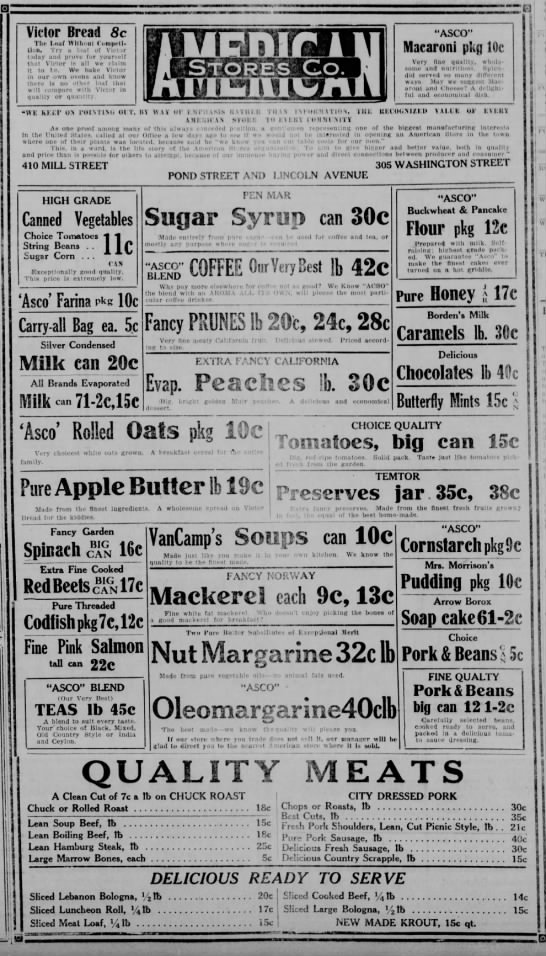
An advertisement from the January 20, 1920 edition of the Bristol Daily Courier:
Report a correction via email | Editorial standards and policies