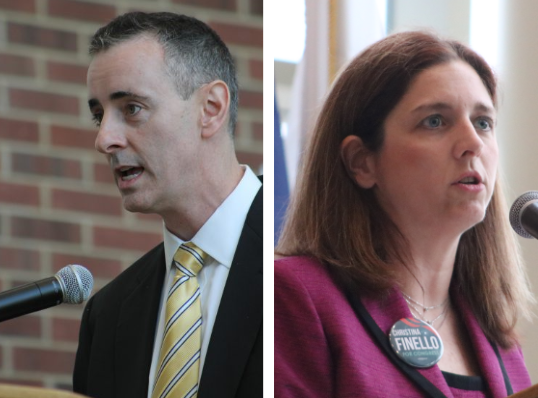
When the year began, 2020 appeared as if it would be one of the more quiet and uneventful campaign seasons in the history of this highly sought-after congressional seat. Suffice to say, events have altered that perception.
First there was the uproar that led to Democrat Debbie Wachspress dropping out of the race and clearing the Democratic field for Christina Finello. Then came the COVID-19 pandemic which caused a nationwide shutdown.
Advertisements
Now, the results of the June 2nd primary reveal whole new dynamics to November’s First Congressional District contest.
Primary Results
When the dust settled, incumbent Republican Congressman Brian Fitzpatrick and Democrat Finello were left standing as the victors in the Republican and Democratic primaries respectively. In a bit of a surprise, though, it was Finello who scored the highest total.
Advertisements
She secured 71,571 votes (77.53 percent) compared to Skylar Hurwitz’s 20,737 (22.47 percent). Broken down by county, Finello got 63,572 votes in Bucks and 7,999 in Montgomery. Hurwitz countered with a 18,443-2,294 vote split.
Meanwhile, Fitzpatrick received 48,017 votes (63.25 percent) while Republican challenger Andrew Meehan pulled in 27,895 (36.75 percent). In Bucks it was 43,289 to 25,121 and in Montgomery County 4,728 to 2,774.
Advertisements
These numbers continue a notable trend for Fitzpatrick, as he’s gotten a smaller percentage of the vote in each successive primary. In 2016 he secured 78 percent and in 2018 it was 67 percent.
Presented below is a precinct-by-precinct map I created for the Fitzpatrick-Meehan match-up.

Now compare it to one I made for the 2018 contest between Fitzpatrick and his then-primary opponent Dean Malik.

Advertisements
You can see that there appears to be a consistent anti-Fitzpatrick pocket in Upper Bucks County while the incumbent improved somewhat in the Doylestown area.
The big differences, however, are in Lower Bucks County. For instance, despite it being his hometown, Fitzpatrick lost some areas of Levittown and ran behind his 2018 pace just about everywhere there. That phenomenon extended into places like Bristol, Northampton, and Upper Southampton.
Advertisements
I wanted to make a similar map of the Democratic contest but Finello’s victory ended up being too large, an outcome I haven’t encountered since Fitzpatrick’s first primary win in 2016.
The Trends of the 1st District
Advertisements
What I was able to compile was a precinct-by-precinct turnout graphic for the 2020 primaries.

Once again we see some important differences between these results and 2018.

Advertisements
It’s evident that the Democratic candidates performed significantly better in Lower Bucks County area like Bensalem, Croydon and Upper Makefield. Democrats also gained ground in other areas such as Hatfield, New Britain, Quakertown and Warminister.
While not exactly predictive, these maps do provide a bit of a road map to the Finello campaign for November.
The State of the Race
Advertisements
Before June 2, it seemed that 2020 would be a relatively low-key year for the First Congressional District race. By early morning, though, Fitzpatrick’s lead over Meehan stood at just 56 percent to 44 percent. Suddenly, there was renewed attention on the race.
The Finello campaign soon released an internal poll showing them down 40-38. A week later, another poll from a Democratic Super PAC found the race tied 46-46. The latter survey also had Biden leading Trump 53-40 in the district.
Advertisements
The purpose of leaking these polls is to show major Democratic groups that might’ve taken a pass on the race, principally EMILY’s List, that Finello can win if she gets financial support. The Democratic nominee needs a major infusion of cash as fundraising has been her main weakness.
So can Finello really flip the seat? Possibly.
Since internal polls aren’t always the best barometers, it’d be useful to examine other numbers.
Advertisements
For example, this is only the second time that the late Mike Fitzpatrick or Brian Fitzpatrick were out-voted by a Democrat in a congressional primary. Then-incumbent Patrick Murphy did it in 2010, but he went on to lose in his re-match with Mike Fitzpatrick that November.
Still, Congressman Brian Fitzpatrick should be concerned as his somewhat lackluster performance in the Republican primary suggests he has some major issues on his right.
More evidence to support this came in May, when he did something he’d never done before: be seen in public with Donald Trump. It’s likely his campaign saw some problem in his own internal numbers and decided he needed to shore up his base.
Advertisements
His 63 percent showing implies that the tarmac meeting didn’t help enough. After all, Meehan was a flawed challenger dogged by a DUI and controversial social media posts. Fitzpatrick should’ve taken this primary in a landslide.
Yet now he must run away from Trump in the general election. In fact, his vote for the Democratic police reform bill indicates he’s already starting to pivot.
Nevertheless, Fitzpatrick remains stuck between a rock and a hard place for the general election. He has to win over those die-hard Trump supporters that backed Meehan, while at the same time not hurting himself too much with moderate voters who are leaning towards casting a Biden-Fitzpatrick split-ticket.
Meanwhile Finello’s near anonymity could wind up being an asset, as 2020 appears to be a year where a “generic Dem” may actually have the advantage. It’s quite a contrast from two years ago, when Fitzpatrick’s attacks on 2018 candidate Scott Wallace’s past helped him secure a victory in a tough national environment.
Advertisements
Another complicating factor is the increasing prevalence of mail-in voting. Led by Trump, the Republican Party is fighting efforts to aid this method of casting a ballot.
Fitzpatrick, however, received a higher percentage of mail-in votes than in-person ones. Undoubtedly he noticed this, and realized that the swing voters most crucial to his re-election are likely to mail in their ballot this November. As a result, his own interests are in direct contrast to his party’s position.
Finally, with coronavirus cases surging again across the nation it appears unlikely that the campaign trail will return to normal this year. Therefore, TV ads and debates will become disproportionately important in what is now anything but a boring race.
Report a correction via email | Editorial standards and policies