Credit: FDA
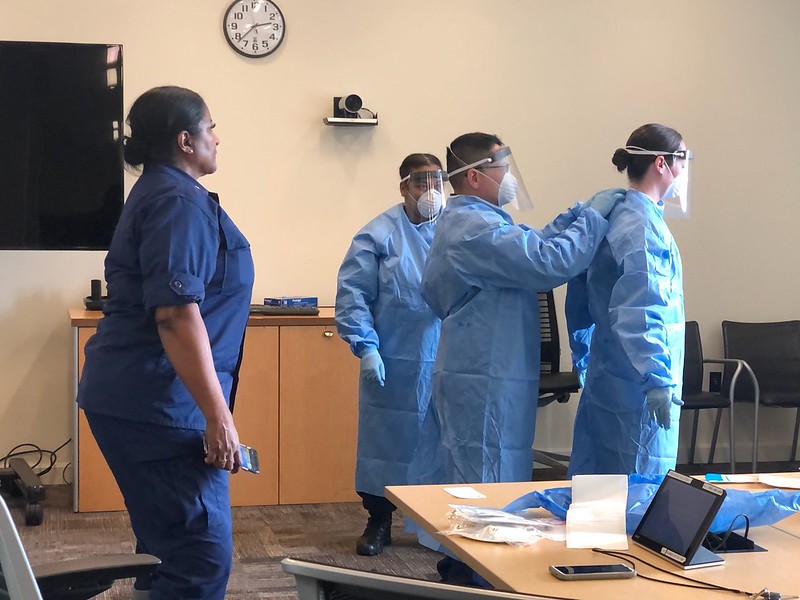
With the possibility of a shortage of masks and gowns becoming a reality, an army of medical personnel, encamped in large tents that dot the landscape of area hospital campuses, remain busy. A stream of cars line up and pull up to the tents, one at a time, for the occupants to be tested for COVID-19, a diseases caused by the novel coronavirus sweeping the planet.
Family Medicine specialist Dr. Rob Danoff is among the medical professionals who participate in this outdoor testing laboratory. It’s an efficient drill: walk up to the car, take the necessary swabs, and head back to the tent. The patient drives away.
Advertisements
“It takes five days for results to come back. Some hospitals have the equipment that work faster; We don’t have those yet,” said Danoff, who is associated with Jefferson Health hospitals. He stressed that coronaviral testing is administered only on a health care provider’s orders, and appointments are required.
He said that the physicians on tent duty see about 40 to 80 cars a day, and the deadly virus that has stilled everyday activities around the globe has, so far, shown no indication of abating.
Experts from the U.S. Centers for Disease Control believe that the worse-before-better predictions may well be attributed to the increase of testing around the country. In its early stages, the contagion was believed to have affected only older citizens, or those with compromised health issues.
Advertisements
Because of recent findings, Danoff said, experts now know that the virus can attack anyone, regardless of age. The elderly are more vulnerable to complications, but anyone could be the victim of the virus that “starts in the lungs and ends in the lungs,” he said.
“I don’t want young people thinking they can’t get sick,” he said.
Advertisements
People of all backgrounds and pre-existing conditions should follow the CDC’s guidelines: wash hands frequently, don’t touch the face, avoid crowds, and practice social distancing by staying six to 10 feet away from others, Danoff advised.
“Patients with heart disease, diabetes, chronic obstructive lung disease (COPD), or other conditions should follow their routines of taking their medications, and keeping control of the situation as best they can,” Danoff said.
Some aren’t taking warnings seriously, like a Falls Township woman who said she was diabetic. She sometimes takes advantage of the early openings for seniors that many stores are offering.
Advertisements
“I’m not worried. Everything’s clean and I think they’re making too much of this. The stores are clean when I go there,” said the woman, who asked not to be named because “my doctor would kill me.”

Credit: Submitted
Others, like Ashley Spencer, say the risk isn’t an option. The 29-year-old Bristol Borough resident has Churg-Strauss Syndrome, a condition so rare – one or two cases in a million each year, according to the CDC – that her doctors at the Cleveland Clinic advised her not to make the journey for evaluation and medications until the crisis is over.
Advertisements
Churg-Strauss Syndrome is a disorder marked by blood vessel inflammation that can restrict blood flow and can damage vital organs. It is also accompanied by other symptoms such as severe allergies, and anaphylactic shock. Her medications include steroids, and chemotherapy treatments. She also has a blood thinner to prevent a clot in her heart from enlarging, she said’

Credit: Submitted
Since the coronavirus snaked its way to the United States, Spencer, a former physical therapist, lives in her bedroom, isolated except for her music, her favorite television shows, Skyping with friends, and Facebook contacts.
Advertisements
Even at home, she is isolated from family members. Despite precautions, like washing her hands every two hours, she is still frightened of the current pandemic.

Credit: Submitted
Spencer’s mother Nora, saying she feels like she’s always walking on eggshells, and panics when the phone rings because, “I’m always afraid something will happen,” she said.
Advertisements
The spread of the virus ensures that her daughter’s confinement isn’t close to ending, after officials extended the stay-at-home policy to April 30.
Report a correction via email | Editorial standards and policies